At the Losvido training range in the Republic of Belarus, peacekeeping units repelled a simulated enemy attack on a humanitarian convoy during the command-and-staff exercise with the CSTO Peacekeeping Forces “Indestructible Brotherhood-2026”.
These days, the 23rd International Combat Sambo Tournament for the Cup of the Secretary General of the Collective Security Treaty Organization, featuring law enforcement personnel from CSTO member states, is being held at the Ognikovo Park Hotel (19 Ognikovo, Istra District, Moscow Region).
At the Losvido training range in the Republic of Belarus, peacekeeping units practiced tactical procedures at a stationary checkpoint as part of the process of coordinating units and practicing joint actions during the command-and-staff exercise with the CSTO Peacekeeping Forces “Indestructible Brotherhood-2026”.
Today, at the Starodorozhsky training range in the Republic of Belarus, servicemen of the CSTO joint NBC protection and medical support formation began practical operations as part of the “Barrier-2026” special exercise.
Welcome address by the CSTO Secretary General Imangali Tasmagambetov at the 13th meeting of the secretaries of the security councils of the CIS member states
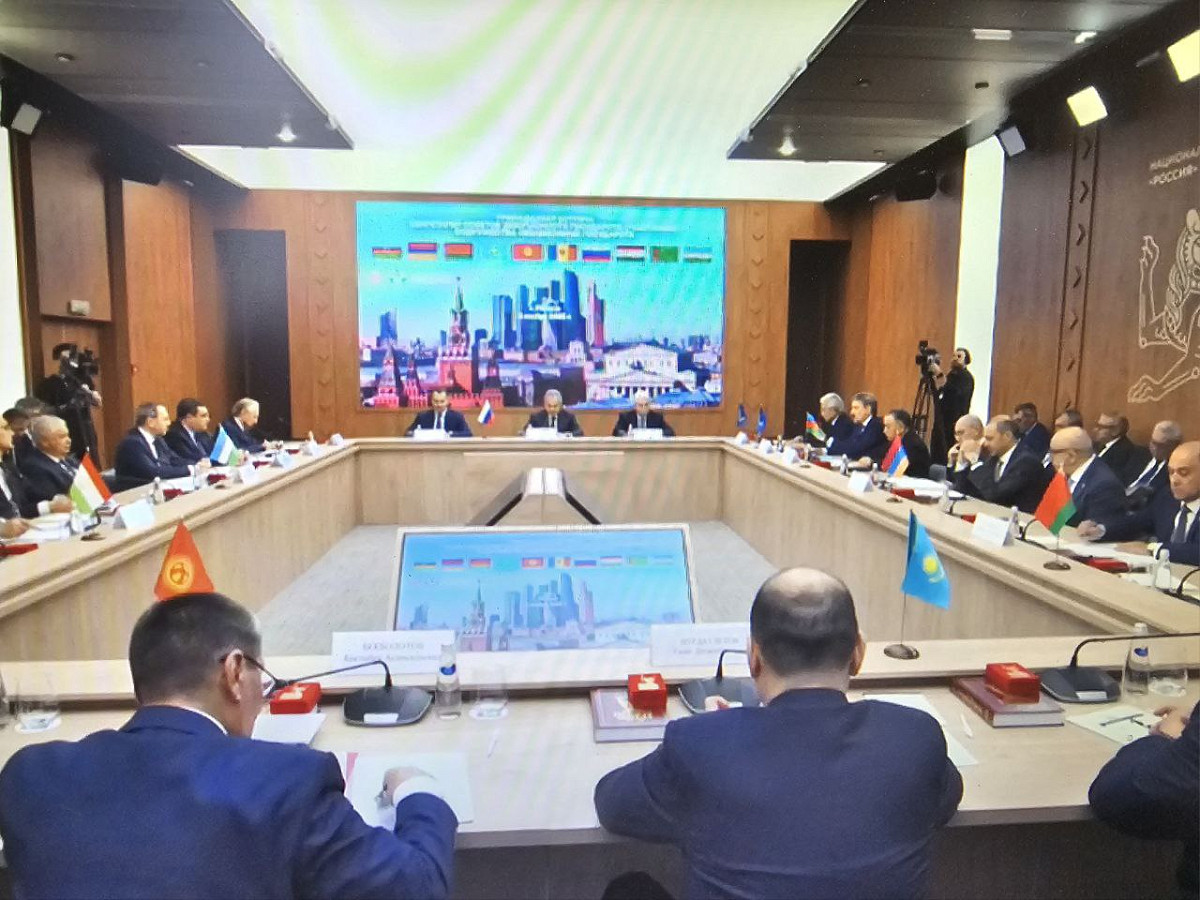 05.11.2025
November 5, 2025, Moscow
National Center “Russia” (Pavilion No. 4)
Dear Sergey Kuzhugetovich!
Dear Secretaries of the Security Councils!
On behalf of the Secretariat of the Collective Security Treaty Organization, I welcome the organizers and participants of the thirteenth meeting of the secretaries of the security councils of the member states of the Commonwealth of Independent States. First of all, I would like to express my sincere gratitude to Sergei Kuzhugetovich Shoigu, Secretary of the Security Council of the Russian Federation, for inviting me to such an important event. The relevance of this format of meetings cannot be overestimated.
Dear colleagues!
Our meeting is taking place in the year of the 80th anniversary of the United Nations. The events dedicated to this anniversary are inextricably linked with another historic anniversary – the 80th anniversary of Victory in World War II. It was the defeat of Nazism, achieved at the cost of unparalleled heroism and the lives of millions of citizens of the Soviet Union and other countries of the Anti-Hitler Coalition, that laid the foundation for a new architecture of international relations aimed at preventing the recurrence of such global disasters in the future.
Unfortunately, the current international political situation and increased confrontation at the global and regional levels continue to be accompanied by a decline in the manageability of the international relations system. This results in crisis situations arising at points where the geopolitical and geo-economic interests of key players intersect. The situation is exacerbated by the use of hybrid technologies, which makes it much more difficult to identify threats and establish facts of violations of national sovereignty.
In Eastern Europe, the main events continue to revolve around the situation in Ukraine, where fighting continues. This is accompanied by tougher Western sanctions against the Russian Federation and the Republic of Belarus, as well as ongoing financial injections and supplies of offensive weapons to Kiev from the US, European countries, and their allies. The risk of serious incidents at nuclear power plants, which could have catastrophic consequences for large areas, including outside the combat zone, has increased significantly.
Challenges to international stability continue to intensify, such as the rapidly expanding use of artificial intelligence for military purposes, mass production and lack of clear regulation of lethal autonomous weapons systems capable of striking targets on land, in the air, on water, and underwater without human involvement, the active use of the internet to disrupt domestic political stability and damage the economic, military, and other interests of other countries, and the intensification of military space activities.
In these difficult conditions, the CSTO is taking measures to maintain stability in the Eurasian space in order to ensure the security of the Organization's member states.
For example, collective efforts to counter cross-border challenges and threats are mainly implemented through planned operational and preventive measures. In 2025, a set of counterterrorism measures was successfully implemented under the code name “Mercenary-2025,” with the goal of blocking channels for recruiting and transporting citizens of the CSTO member states to participate in terrorist activities. The operation has been completed, and we are currently summarizing the results, which we will report to the secretaries of the CSTO security councils in accordance with the established procedure.
Operation “Channel” to curb the spread of narcotic drugs is being actively implemented. In May and September of this year, the CSTO conducted the subregional operations “Channel-Mountain Outpost” and “Channel-Western Dvina,” with international coordination headquarters located in the Kyrgyz Republic and the Republic of Belarus, respectively. As a result, more than 6 tons of narcotic drugs and psychotropic substances were seized from offenders. The experience gained in anti-drug cooperation within the framework of these operations with law enforcement agencies of China, Iran, and the United Arab Emirates, as well as representatives of the UNODC, the SCO, the CIS, and the EAG, deserves attention.
A few words about the situation in the Central Asian collective security region. Afghanistan remains a serious threat to the security of the CSTO member states in the long term. This country still has a long way to go to achieve political stability and prosperity. Its security, successful state-building, and steady socio-economic development are in the interests of all its neighbors, including the CSTO members, who are committed to productive international cooperation.
Taking these factors into account, the fundamental task for the CSTO remains the implementation of the Special Interstate Policy for strengthening sections of the Tajik-Afghan Border, which was approved by the leaders of our countries in November 2024. The Policy includes specific measures aimed at ensuring the security of the southern part of the Organization's area of responsibility. This year, we have begun to implement the measures of the first stage of the Policy.
Just recently, training involving the CSTO special forces were completed in the Republic of Kazakhstan, where, during a special operation, issues related to the neutralization (destruction) of illegal armed groups were worked out against the backdrop of a simulated military-political situation in this collective security region.
Dear colleagues!
During today's meeting, we will consider a wide range of issues related primarily to security challenges and threats in our areas of responsibility and possible joint response measures. The Collective Security Treaty Organization is taking and will continue to take comprehensive measures to maintain regional security, prevent crises, and combat terrorism, extremism, transnational crime, and illegal migration.
The potential for improving the effectiveness of our activities lies in close cooperation between regional organizations such as the CIS, the CSTO, and the SCO.