At the Losvido training range in the Republic of Belarus, peacekeeping units practiced tactical procedures at a stationary checkpoint as part of the process of coordinating units and practicing joint actions during the command-and-staff exercise with the CSTO Peacekeeping Forces “Indestructible Brotherhood-2026”.
Today, at the Starodorozhsky training range in the Republic of Belarus, servicemen of the CSTO joint NBC protection and medical support formation began practical operations as part of the “Barrier-2026” special exercise.
Today, at the Losvido training range in Belarus, the CSTO Collective Peacekeeping Forces Commander was presented with a mandate to conduct a peacekeeping operation at the command post as part of the “Indestructible Brotherhood-2026” command-and-staff exercise.
Servicemen of the Combined Arms Army of the Central Military District (CMD) have arrived in the Republic of Belarus to take part in the command-and-staff exercise with the CSTO Peacekeeping Forces “Indestructible Brotherhood-2026” and the special exercise with the CSTO joint NBC protection and medical support formation “Barrier-2026”.
Regular meeting of the CSTO Committee of Secretaries of Security Councils held in Moscow
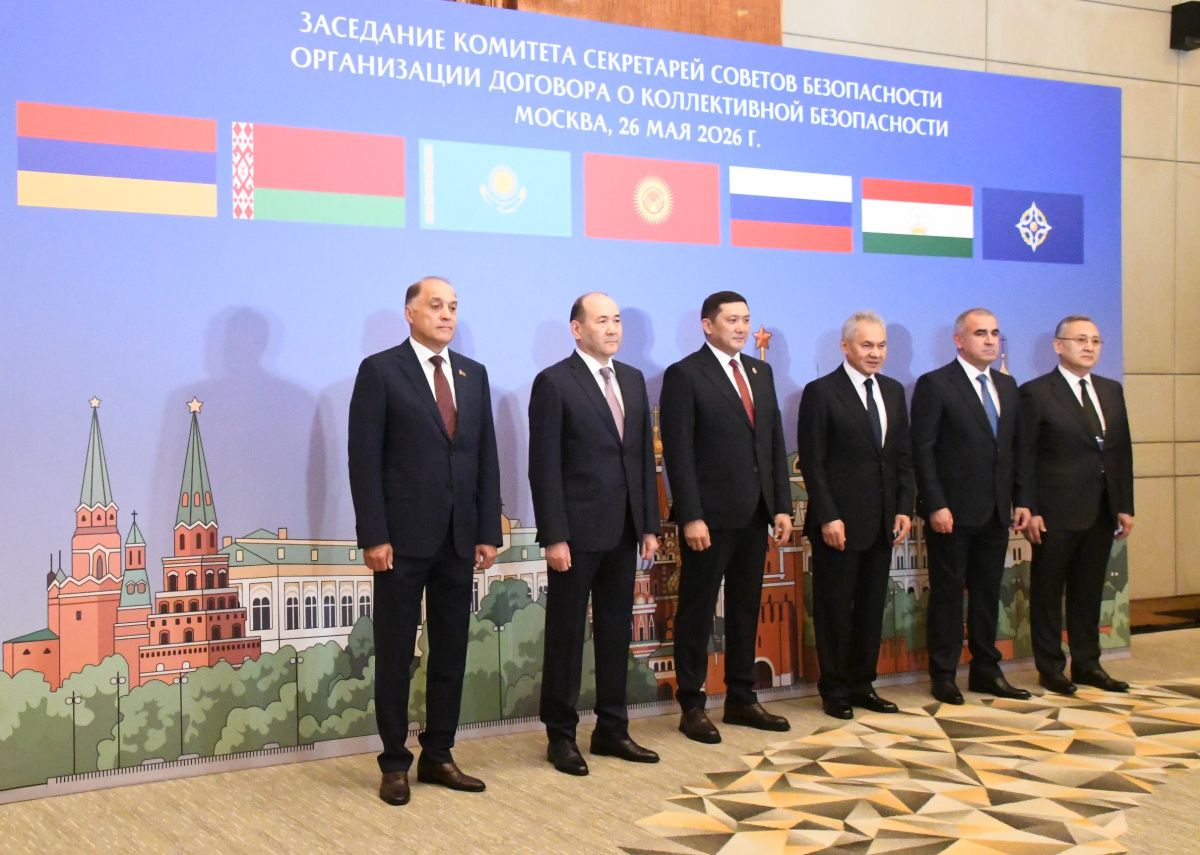 26.05.2026
On May 26, 2026, a regular meeting of the CSTO Committee of Secretaries of Security Councils (CSSC) was held in Moscow under the chairmanship of the Russian side, with the participation of CSTO Secretary General Talatbek Masadykov. The participants conducted a substantive exchange of views on issues related to strengthening security in the CSTO area of responsibility.
Chairman of the CSTO Committee of Secretaries of Security Councils and Secretary of the Security Council of the Russian Federation Sergey Shoigu noted in particular: “The main threat comes from NATO and the countries of the so-called ‘civilized’ Europe that are part of the bloc, which have fallen into a state of revanchist and militaristic fervor. In the Alliance Secretary General’s 2025 report, Mark Rutte proudly states that military spending by all member states has increased, exceeding a total of USD 1.5 trillion. The leaders are far from the wealthiest countries — Eastern European states and the Baltic countries, which spend around 4% of their national GDPs allegedly on ‘defense’.”
In his remarks, Talatbek Masadykov emphasized: “The situation in the Eastern European collective security region remains the most difficult. Amid the effective collapse of the system of international treaties that for a long time served as the foundation of the European security architecture, a number of Western leaders have embarked on a course toward militarization and preparation for war.”
On the sidelines of the meeting, the Russian and Belarusian sides signed a Cooperation Plan on Information Security.
Following the meeting, a number of documents were adopted, including the draft Decision of the CSTO Collective Security Council “On the Anti-Terrorism Strategy of the Member States of the Collective Security Treaty Organization until 2030” and the Decision of the CSTO Committee of Secretaries of Security Councils “On the Package of Measures for the Implementation of the Anti-Drug Strategy of the CSTO Member States for 2026–2030.”