An international scientific and practical conference entitled “Transformation of the Global Security System and the Shaping of a Eurasian Security Framework” was held at Moscow State Linguistic University (MSLU).
Today, a conference entitled “The Role and Place of Media in CSTO Member States in Efforts to Contain Crisis (Emergency) Situations in Collective Security Regions” was held in Minsk.
An international scientific and practical conference entitled “The Situation in the Middle East, North Africa and the Sahara-Sahel Region: Development Forecasts for 2027” was held in Moscow, organized by the Center for Scientific and Analytical Information of the Institute of Oriental Studies of the Russian Academy of Sciences.
On October 18, 2026, the “Cobalt-2026” special exercise opened in the Republic of Tajikistan, in accordance with the 2026 Plan for the Joint Training of Command and Control Bodies and Formations of Forces and Assets of the CSTO Collective Security System. The exercise involves special units of internal affairs and national security agencies, internal troops (National Guard), special services and anti-drug agencies, as well as rescue units incorporated into the Special Purpose Forces formations of the CSTO Collective Operational Reaction Forces (CORF).
From October 13 to 16, 2025, the 23rd International Combat Sambo Tournament for the Cup of the Secretary General of the Collective Security Treaty Organization, featuring law enforcement personnel from CSTO member states, was held at the Ognikovo Park Hotel (19 Ognikovo, Istra District, Moscow Region).
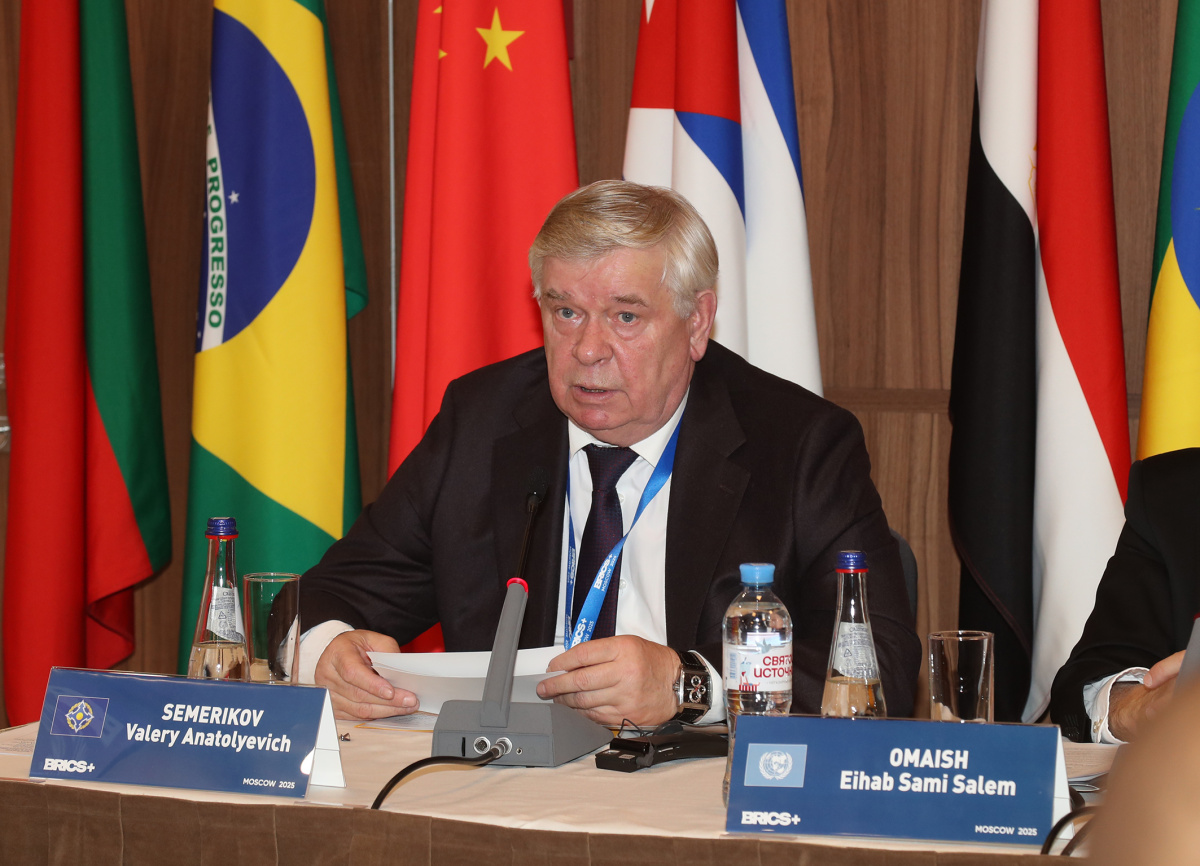
The CSTO Deputy Secretary General Valery Semerikov took part in the “BRICS+ 2025 Anti-Terrorism Conference: National and Regional Counter-Terrorism Strategies in the Context of Emerging Challenges and Security Threats.”
 05.12.2025
The CSTO Deputy Secretary General Valery Semerikov took part in the “BRICS+ 2025 Anti-Terrorism Conference: National and Regional Counter-Terrorism Strategies in the Context of Emerging Challenges and Security Threats”, held in Moscow.
The forum brought together more than 100 representatives from competent authorities, scientific and socio-political circles in BRICS countries and partner states, as well as counterterrorism units from international organizations.
Valery Semerikov presented the CSTO's approaches to countering terrorism and provided information on the measures taken by the Organization in this area.
“The recent surge in terrorist threats around the world is a direct consequence of the collapse of the international security system that had existed for decades and its current structural restructuring. With the breakdown of previous agreements and global confrontation, coupled with the spread of armed violence in conflict zones, terrorism and extremism are no longer the tools of marginal groups but are increasingly being used by certain countries and blocs to further their political and economic interests. At the same time, terrorist groups, having been reborn as international terrorist organizations, set themselves the goal of paralyzing the independent system of state governance, or even destroying the country chosen as their victim. Terrorism is becoming an increasingly complex threat, integrated into the system of hybrid warfare," Valery Semerikov noted.
The CSTO Deputy Secretary General spoke about the comprehensive operational and preventive operations “Channel,” “Illegal,” “Mercenary,” and “PROXY,” presented their results, and emphasized that representatives of relevant structures of partner international organizations, such as the UN, the CIS, the SCO, as well as third countries, are participating in these activities.
Valery Semerikov highlighted the implementation of the Special Interstate Policy for strengthening sections of the Tajik-Afghan Border as an important area of work for the CSTO, designed to protect member states from the full range of challenges and threats emanating from the territory of Afghanistan.