An international scientific and practical conference entitled “Transformation of the Global Security System and the Shaping of a Eurasian Security Framework” was held at Moscow State Linguistic University (MSLU).
Today, a conference entitled “The Role and Place of Media in CSTO Member States in Efforts to Contain Crisis (Emergency) Situations in Collective Security Regions” was held in Minsk.
An international scientific and practical conference entitled “The Situation in the Middle East, North Africa and the Sahara-Sahel Region: Development Forecasts for 2027” was held in Moscow, organized by the Center for Scientific and Analytical Information of the Institute of Oriental Studies of the Russian Academy of Sciences.
On October 18, 2026, the “Cobalt-2026” special exercise opened in the Republic of Tajikistan, in accordance with the 2026 Plan for the Joint Training of Command and Control Bodies and Formations of Forces and Assets of the CSTO Collective Security System. The exercise involves special units of internal affairs and national security agencies, internal troops (National Guard), special services and anti-drug agencies, as well as rescue units incorporated into the Special Purpose Forces formations of the CSTO Collective Operational Reaction Forces (CORF).
From October 13 to 16, 2025, the 23rd International Combat Sambo Tournament for the Cup of the Secretary General of the Collective Security Treaty Organization, featuring law enforcement personnel from CSTO member states, was held at the Ognikovo Park Hotel (19 Ognikovo, Istra District, Moscow Region).
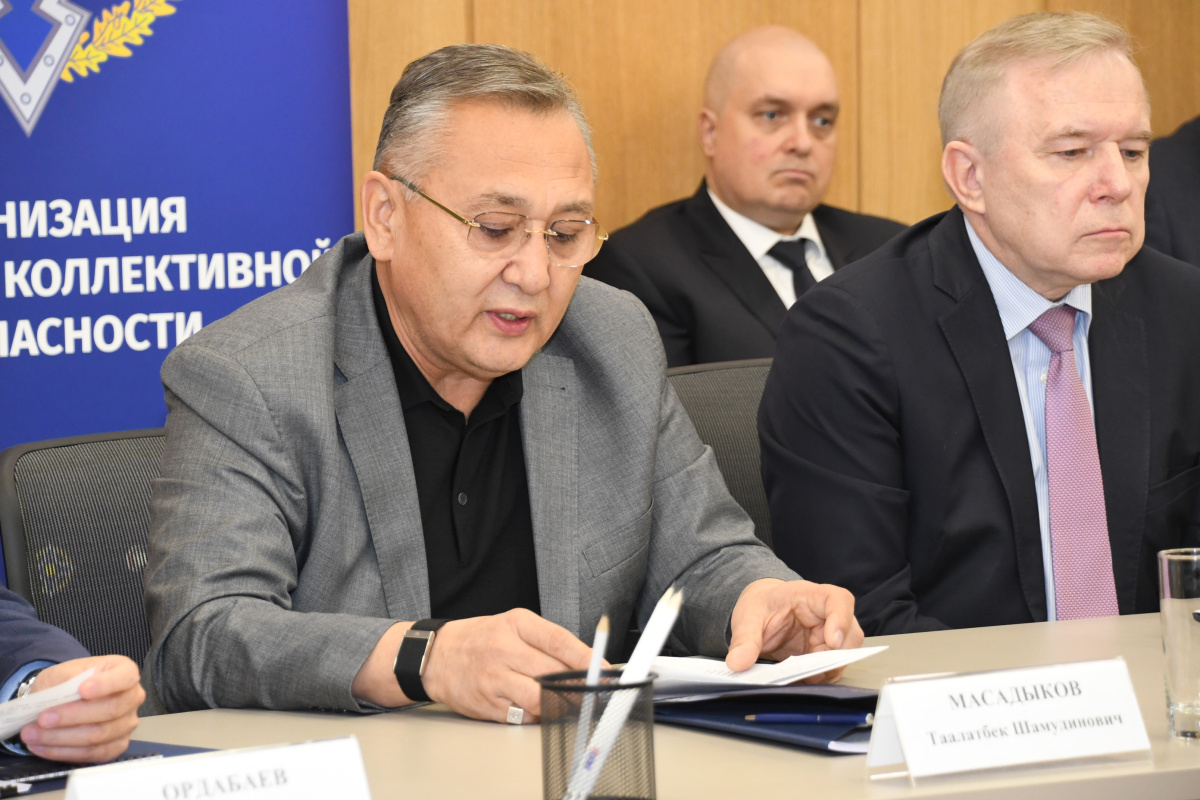
Opening remarks by CSTO Secretary General Talatbek Masadykov at the round table “Kazakhstan–Central Asia–Greater Eurasia: resilience and security amid new challenges”
 11.09.2026
Dear colleagues,
Good afternoon!
Thank you for taking part in the round table devoted to the constitutional reform carried out in the Republic of Kazakhstan.
The CSTO Secretariat, the Institute of China and Contemporary Asia, together with the Center for Social and Conservative Policy, continue to work jointly on the conceptual analytical report “The CSTO as a space for security and development: prospects for inter-platform cooperation,” which is scheduled to be presented at a working session of the CSTO Secretariat as part of the 4th Minsk International Conference on Eurasian Security in November 2026.
At the previous event held at the CSCP, we discussed the role and place of the CSTO as a collective security institution in the architecture of Greater Eurasia. Today, our focus is on Kazakhstan: the constitutional reform carried out in the country and, as one of its outcomes, the elections to the Kurultai, as well as an issue of paramount importance for the Central Asian region related to ensuring water and energy security.
The purpose of the reform in Kazakhstan is to update the country's legal system and bring it into line with the state's goals and objectives.
Kazakhstan's experience in this area can without exaggeration be called innovative; it is intended to unlock the potential of the state and society and optimize approaches and methods for addressing pressing challenges. This experience may be highly useful for other Eurasian countries, and therefore I look forward to a substantive discussion on this topic.