An international scientific and practical conference entitled “The Situation in the Middle East, North Africa and the Sahara-Sahel Region: Development Forecasts for 2027” was held in Moscow, organized by the Center for Scientific and Analytical Information of the Institute of Oriental Studies of the Russian Academy of Sciences.
On October 18, 2026, the “Cobalt-2026” special exercise opened in the Republic of Tajikistan, in accordance with the 2026 Plan for the Joint Training of Command and Control Bodies and Formations of Forces and Assets of the CSTO Collective Security System. The exercise involves special units of internal affairs and national security agencies, internal troops (National Guard), special services and anti-drug agencies, as well as rescue units incorporated into the Special Purpose Forces formations of the CSTO Collective Operational Reaction Forces (CORF).
From October 13 to 16, 2025, the 23rd International Combat Sambo Tournament for the Cup of the Secretary General of the Collective Security Treaty Organization, featuring law enforcement personnel from CSTO member states, was held at the Ognikovo Park Hotel (19 Ognikovo, Istra District, Moscow Region).
Today, the final stages of the command-and-staff exercise with the CSTO Peacekeeping Forces “Indestructible Brotherhood-2026” and the special exercise with the CSTO joint NBC protection and medical support formation “Barrier-2026” took place at the Losvido and Starodorozhsky training ranges in the Republic of Belarus.
On October 15–16, a CSTO, CIS and SCO conference on security issues in Central Asia and Afghanistan was held in Moscow as part of Russia’s CSTO chairmanship programme.
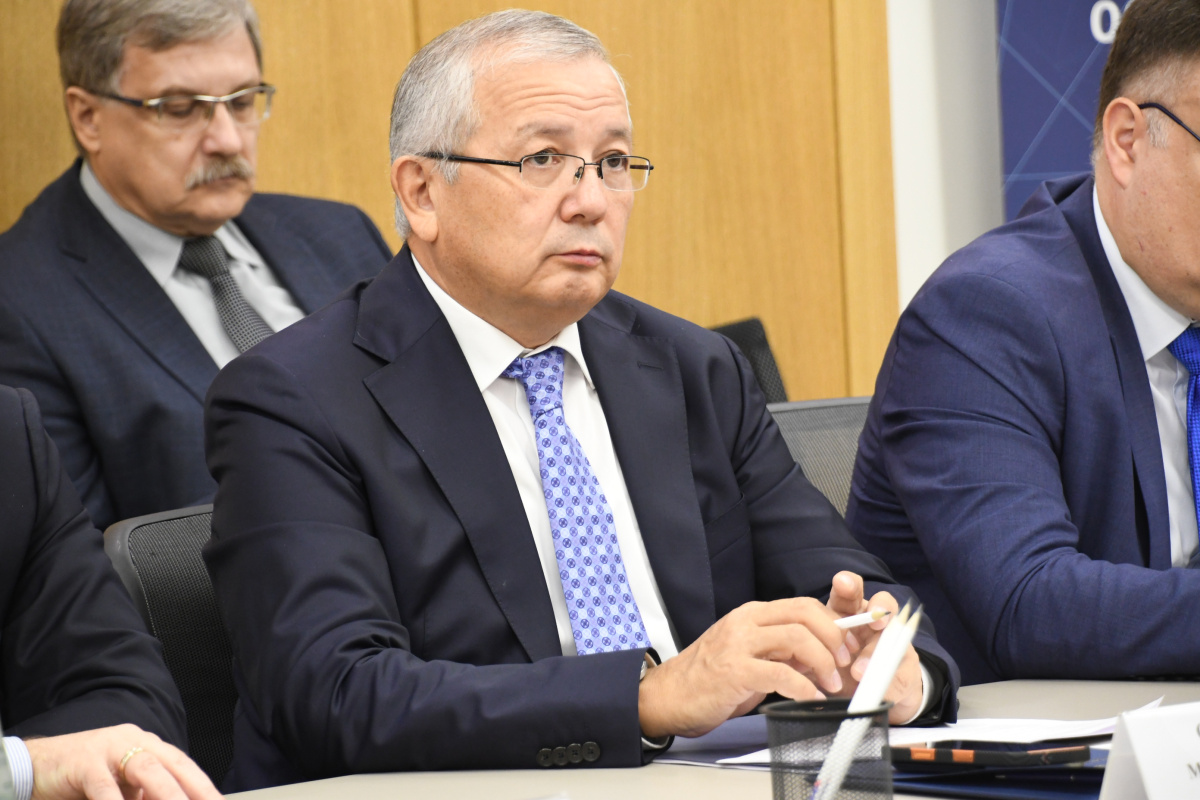
Statement by Permanent Representative of the Republic of Kazakhstan to the CSTO Marat Syzdykov
 11.09.2026
Dear participants of the round table, dear friends!
First of all, I would like to thank the organizers for the invitation and the opportunity to discuss such a relevant topic as resilience and security in Eurasia.
For Kazakhstan, located in the very heart of the Eurasian continent, these issues are not theoretical but have a purely practical significance.
Our main response to new challenges is profound political modernization, at the core of which is the large-scale constitutional reform in Kazakhstan.
The constitutional amendments adopted as a result of the 2022 referendum brought about significant changes in various spheres of Kazakh society.
They affected key elements of the political system: the presidency, the legislative, executive and judicial branches of government, the electoral system, and mechanisms for protecting citizens' rights.
The Constitutional Court was re-established, the role of the Human Rights Commissioner was strengthened, opportunities for citizens to protect their rights were expanded, the procedure for forming representative bodies of government was modernized, and the election of rural akims was introduced. Steps were taken to strengthen interaction and increase the political responsibility of state institutions.
These transformations laid the foundation for the country's next stage of development.
As you know, on March 15, 2026, a referendum was held in Kazakhstan, resulting in the adoption of a new Constitution.
The Constitution is based on the values of a Just Kazakhstan, where the individual, their life, rights and freedoms are at the center of state policy.
Under the renewed balance of powers, the President has retained his key role as a symbol of independence and national unity, and as the guarantor of compliance with the Constitution and the legitimate rights and freedoms of citizens.
Kazakhstan remains a presidential republic in which the President is the highest official of the state, Supreme Commander-in-Chief of the Armed Forces, appoints the heads of all law enforcement agencies, determines the main directions of the country's domestic and foreign policy, and represents our state on the international stage.
At the same time, the modernization provides for a transformation of the parliamentary system.
As of July 1, 2026, Kazakhstan's bicameral parliament was abolished, and its powers were transferred to a single-chamber body, the Kurultai. It consists of 145 deputies elected under a proportional system. This significantly increases the role of political parties and, at the same time, their responsibility to society.
I would like to dwell separately on the results of the first elections to the Kurultai. More than 74 percent of voters took part in the vote. The high turnout demonstrated that citizens fully support the large-scale transformations being implemented in Kazakhstan.
The international community recognized the election results, confirming their full compliance with national legislation and all applicable requirements.
The beginning of the Kurultai's work marks the start of fundamental institutional changes in the system of public administration, as this body plays an important role in shaping the system of government.
In particular, judges of the Constitutional Court, members of the Central Election Commission and the Supreme Audit Chamber will be appointed in coordination with the Kurultai.
The deputies are empowered to appoint and dismiss judges of the Supreme Court upon the proposal of the President.
The Kurultai has also been granted the authority to lift the legal immunity of judges of the Constitutional Court and Supreme Court, as well as deputies.
Members of the legislative body will approve reports of the Supreme Audit Chamber on the execution of the republican budget and hear the annual report of the Constitutional Court.
In addition, deputies have the right to express a vote of no confidence in the Government and submit proposals to the President to dismiss individual members of the Government.
In short, the Kurultai has been granted broad powers to shape the executive and judicial branches of government, as well as to address strategic issues of decisive importance for the country's future.
In addition, the Kazakhstan People's Council will be established in the near future. This will be the first supreme consultative body in the history of Kazakhstan to embody the ethnic, regional, social and socio-political diversity of our country. This constitutional body is vested with the right of legislative initiative.
An important element of the renewed architecture of government was the establishment of the position of Vice President of the Republic of Kazakhstan. This position was introduced to strengthen institutional continuity and the efficiency of governance. The Vice President, on instructions from the Head of State, represents him in interaction with the Kurultai, the Government and other state bodies, as well as political parties, public associations and international organizations.
Now, let me turn to how all of this relates to Kazakhstan's security and regional role. We are convinced that domestic political stability is the foundation of external predictability.
The updated Foreign Policy Concept of the Republic of Kazakhstan for 2020–2030, adopted this year, retains its unchanged principles of multi-vector diplomacy, pragmatism and the protection of national interests.
We continue our policy of expanding cooperation with multilateral organizations in the field of politics and security in Europe and Eurasia, including within the CSTO. For our region, this means that Kazakhstan remains a responsible partner and a bridge between East and West, North and South.
In conclusion, I would like to emphasize that Kazakhstan has chosen the path of evolutionary modernization. Its results should be viewed in the broader context of the large-scale transformations being carried out at the initiative of the Head of State within the framework of the basic formula of state power: “Strong President – Influential Kurultai – Accountable Government.”
Thank you for your attention.