An international scientific and practical conference entitled “Transformation of the Global Security System and the Shaping of a Eurasian Security Framework” was held at Moscow State Linguistic University (MSLU).
Today, a conference entitled “The Role and Place of Media in CSTO Member States in Efforts to Contain Crisis (Emergency) Situations in Collective Security Regions” was held in Minsk.
An international scientific and practical conference entitled “The Situation in the Middle East, North Africa and the Sahara-Sahel Region: Development Forecasts for 2027” was held in Moscow, organized by the Center for Scientific and Analytical Information of the Institute of Oriental Studies of the Russian Academy of Sciences.
On October 18, 2026, the “Cobalt-2026” special exercise opened in the Republic of Tajikistan, in accordance with the 2026 Plan for the Joint Training of Command and Control Bodies and Formations of Forces and Assets of the CSTO Collective Security System. The exercise involves special units of internal affairs and national security agencies, internal troops (National Guard), special services and anti-drug agencies, as well as rescue units incorporated into the Special Purpose Forces formations of the CSTO Collective Operational Reaction Forces (CORF).
From October 13 to 16, 2025, the 23rd International Combat Sambo Tournament for the Cup of the Secretary General of the Collective Security Treaty Organization, featuring law enforcement personnel from CSTO member states, was held at the Ognikovo Park Hotel (19 Ognikovo, Istra District, Moscow Region).
The CSTO Secretariat hosted a round table on the formation of a new architecture for international relations
 25.09.2025
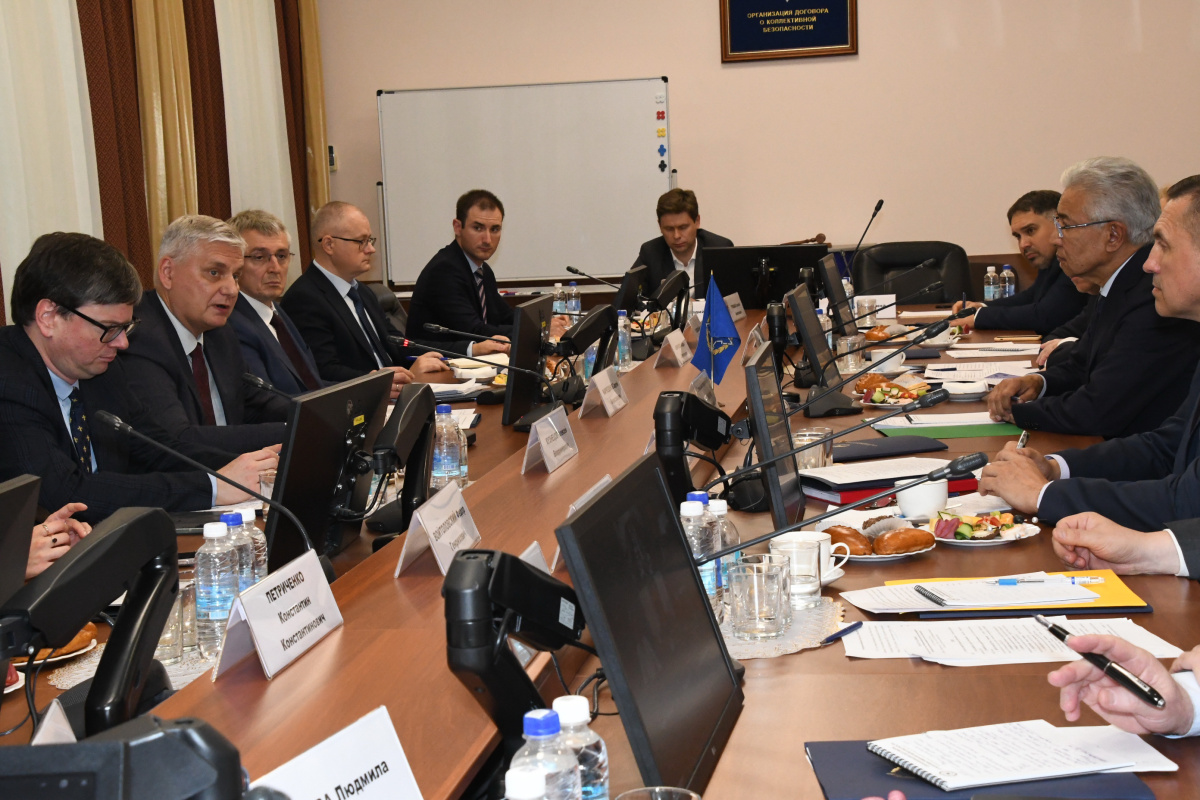
On September 25, 2025, the Secretariat of the Collective Security Treaty Organization hosted a round table discussion on “The Emerging Architecture of International Relations: Prospects for the Eurasian Security System.” The event brought together leading representatives of the analytical community and experts from the foreign ministries of the CSTO member states.
The discussion was attended by leaders of key scientific and analytical centers in Russia, including Mikhail Golovnin, Director of the Institute of Economics of the Russian Academy of Sciences, Director of the Institute of Europe at the Russian Academy of Sciences Alexei Gromyko, Director of the Institute of World Economy and International Relations at the Russian Academy of Sciences Alexei Kuznetsov, Leading Research Fellow at the Institute of International Studies at MGIMO University Sergei Markedonov, and Ambassador-at-Large at the Russian Ministry of Foreign Affairs Alexander Trofimov.
Experts from the Republic of Belarus, the Republic of Kazakhstan, the Kyrgyz Republic, and the Republic of Tajikistan also joined the discussion via videoconferencing.
The CSTO Secretary General Imangali Tasmagambetov welcomed the event participants. In his speech, he emphasized the importance of joint efforts in the context of an unstable international situation. “In a situation of significantly growing challenges and threats, we strive to gain a deeper understanding of what is happening in the world and in our region, to develop and adopt measures necessary to protect the interests of the CSTO member states. This is what motivates us to strengthen cooperation with the expert community,” the CSTO Secretary General said.
The dialogue covered issues related to cooperation between integration associations in the Eurasian space – the CSTO, the CIS, and the EAEU – as well as the prospects for forming a Greater Eurasian Partnership. Particular attention was paid to supporting the "Issyk-Kul Expert Initiative", which aims to deepen cooperation between think tanks in the region.
The roundtable participants developed recommendations aimed at further strengthening Central Eurasia as an area of security, stability, and sustainable development.