An international scientific and practical conference entitled “Transformation of the Global Security System and the Shaping of a Eurasian Security Framework” was held at Moscow State Linguistic University (MSLU).
Today, a conference entitled “The Role and Place of Media in CSTO Member States in Efforts to Contain Crisis (Emergency) Situations in Collective Security Regions” was held in Minsk.
An international scientific and practical conference entitled “The Situation in the Middle East, North Africa and the Sahara-Sahel Region: Development Forecasts for 2027” was held in Moscow, organized by the Center for Scientific and Analytical Information of the Institute of Oriental Studies of the Russian Academy of Sciences.
On October 18, 2026, the “Cobalt-2026” special exercise opened in the Republic of Tajikistan, in accordance with the 2026 Plan for the Joint Training of Command and Control Bodies and Formations of Forces and Assets of the CSTO Collective Security System. The exercise involves special units of internal affairs and national security agencies, internal troops (National Guard), special services and anti-drug agencies, as well as rescue units incorporated into the Special Purpose Forces formations of the CSTO Collective Operational Reaction Forces (CORF).
From October 13 to 16, 2025, the 23rd International Combat Sambo Tournament for the Cup of the Secretary General of the Collective Security Treaty Organization, featuring law enforcement personnel from CSTO member states, was held at the Ognikovo Park Hotel (19 Ognikovo, Istra District, Moscow Region).
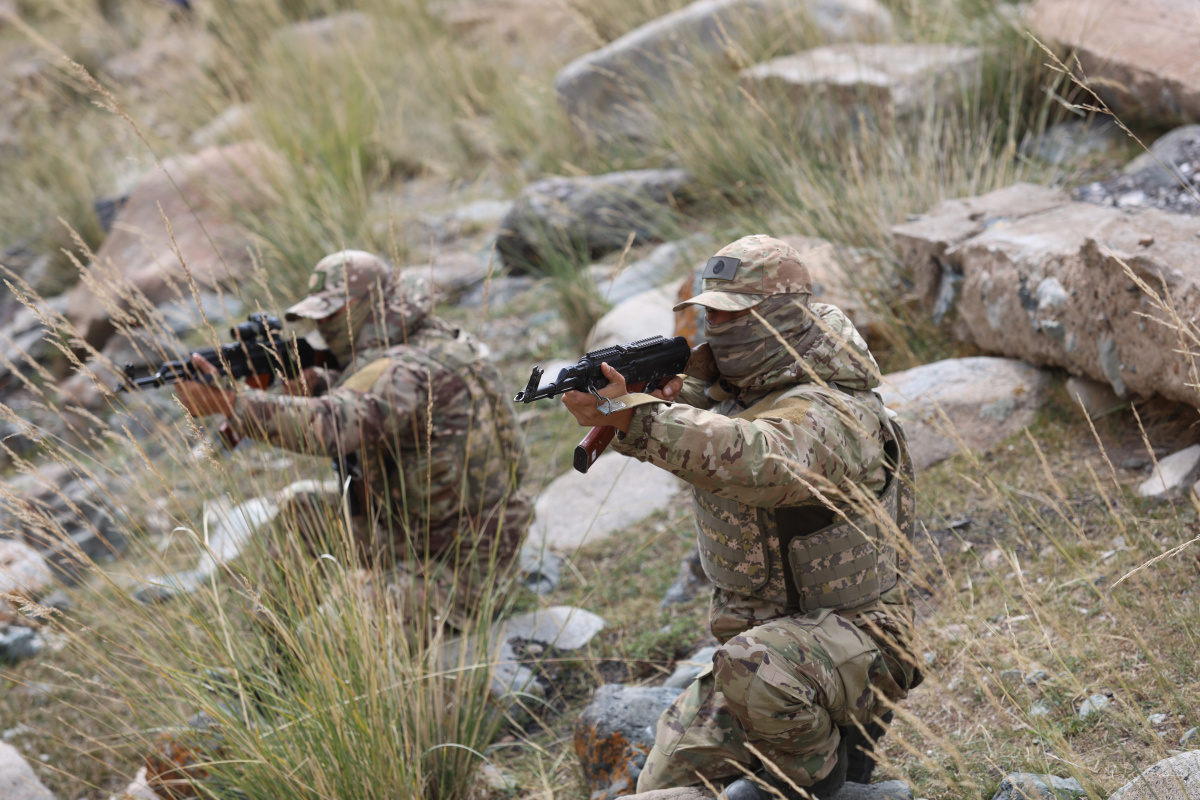
During the “Echelon-2024” training, logistics units practiced their actions in mountainous conditions
 10.09.2024
In Kyrgyzstan, the “Echelon-2024” special training with logistical support forces and means is being organized to improve the coherence and efficiency of the work of the logistical, technical and medical support bodies of the CSTO Collective Security Treaty Organization in preparation for and during the conduct of a joint operation.
Particular attention is being paid to the actions of logistical support units during the regrouping of CSTO CRRF contingents in the areas where the joint operation is being conducted. At the firing range on the route of the convoys, feeding, heating, refueling and technical assistance points have been set up. The technical assistance point is equipped, in particular, with a light wheeled evacuation tractor KET-L, a Ural-based crane and a special technical assistance vehicle.
A mobile hospital was deployed at the training range, which included forces and means of the Ministry of Defense, the Ministry of Health and the Ministry of Emergency Situations of the Kyrgyz Republic, designed to provide qualified medical care to the wounded, sick and injured. It includes a surgical complex, a radiology complex, a diagnostic laboratory, a reanimobile, a disinfection unit and a pharmacy.
The actions of logistical support units were also practiced at the “Edelweiss” Mountain Training Center of the Armed Forces of the Kyrgyz Republic, designed to train specialists in mountain training, at an altitude of 2,300 meters above sea level. Here, the transportation and delivery of logistical supplies was carried out by a combined method using air, road and pack transport.
In order to organize the delivery of cargo or replenishment of materiel for units that were separated from the main forces, the forces and means of a separate rear base practiced loading cargo onto air transport for parachute ejection in the designated area. An-26 military transport aircraft of the Armed Forces of the Kyrgyz Republic was used as an air transport. A supply convoy was dispatched to the area of the cargo release for its subsequent delivery.
For further transportation and delivery of cargo in the mountainous terrain, a pack-transportation section of the unit operating apart from the main forces, consisting of 15 pack cattle, was concentrated in the area of material transfer. Yaks, donkeys and horses were used as pack animals.
The training was designed to have the pack transport unit deliver cargo to a designated point near a mountain river. The transfer of cargo across the water obstacle was accomplished by rope. Upon completion of the water crossing, the materiel was successfully loaded onto vehicles for delivery to the detached unit's location.
During the “Echelon-2024” special training with logistical support forces and means, which is being conducted under the charge of Colonel Aibek Daiyrkul uulu, the deployment of a rear command post, a collection point for damaged vehicles, the actions of repair and evacuation and evacuation teams, the organization of repair and recovery work on military equipment at the assembly point of damaged vehicles in the interests of the CSTO CRRF contingent, as well as issues of comprehensive medical support, were also practiced.
On the territory of the Kyrgyz Republic, under the charge of Colonel Artur Temirov, First Deputy Chief of General Staff of the Armed Forces of the Kyrgyz Republic, a command-staff training with the CSTO Collective Rapid Reaction Forces “Interaction-2024”, a special training with intelligence forces and means “Search-2024”, and a special training with logistical forces and means “Echelon-2024” are being conducted.
Contingents of the CSTO Troops (Collective Forces) of the Republic of Belarus, the Republic of Kazakhstan, the Kyrgyz Republic, the Russian Federation and the Republic of Tajikistan are taking part in the training. Among them are military contingents, formations of special-purpose forces from among the special units of the internal affairs (police), security and special services bodies, authorized bodies in the field of prevention and elimination of the consequences of emergency situations, as well as operational groups of the CSTO Joint Staff and the CSTO Secretariat. A total of about 1,500 servicemen and up to 300 units of weapons, military and special equipment, including aircraft, various types of UAVs, combat boats and air defense equipment, are involved.