An international scientific and practical conference entitled “The Situation in the Middle East, North Africa and the Sahara-Sahel Region: Development Forecasts for 2027” was held in Moscow, organized by the Center for Scientific and Analytical Information of the Institute of Oriental Studies of the Russian Academy of Sciences.
On October 18, 2026, the “Cobalt-2026” special exercise opened in the Republic of Tajikistan, in accordance with the 2026 Plan for the Joint Training of Command and Control Bodies and Formations of Forces and Assets of the CSTO Collective Security System. The exercise involves special units of internal affairs and national security agencies, internal troops (National Guard), special services and anti-drug agencies, as well as rescue units incorporated into the Special Purpose Forces formations of the CSTO Collective Operational Reaction Forces (CORF).
From October 13 to 16, 2025, the 23rd International Combat Sambo Tournament for the Cup of the Secretary General of the Collective Security Treaty Organization, featuring law enforcement personnel from CSTO member states, was held at the Ognikovo Park Hotel (19 Ognikovo, Istra District, Moscow Region).
Today, the final stages of the command-and-staff exercise with the CSTO Peacekeeping Forces “Indestructible Brotherhood-2026” and the special exercise with the CSTO joint NBC protection and medical support formation “Barrier-2026” took place at the Losvido and Starodorozhsky training ranges in the Republic of Belarus.
On October 15–16, a CSTO, CIS and SCO conference on security issues in Central Asia and Afghanistan was held in Moscow as part of Russia’s CSTO chairmanship programme.
The CSTO Deputy Secretary General Samat Ordabayev met with the UN Secretary General's Special Representative for Central Asia Kakha Imnadze
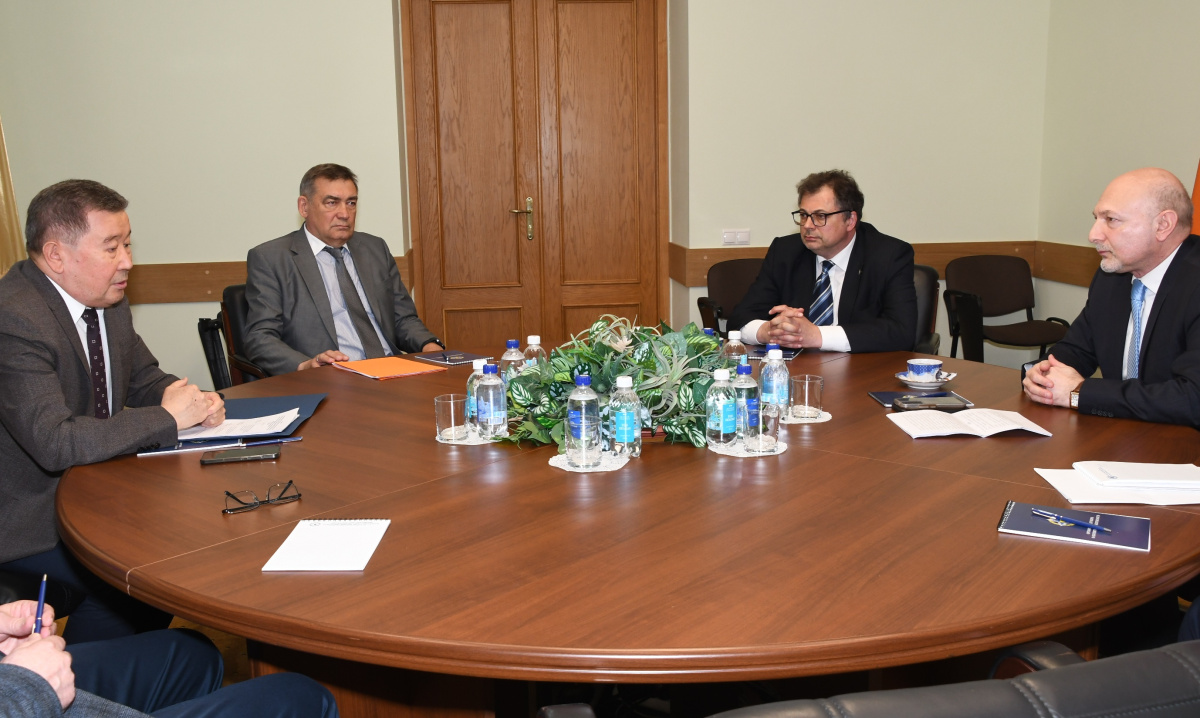 27.05.2025
On 27 May 2025, the CSTO Secretariat hosted a working meeting between the Deputy Secretary General of the Collective Security Treaty Organization Samat Ordabayev and the Special Representative of the UN Secretary General for Central Asia, Head of the UN Regional Centre for Preventive Diplomacy for Central Asia (UNRCCA) Kakha Imnadze.
During the meeting, the sides noted the dynamic development of contacts between the CSTO Secretariat and the UNRCCA, as well as other specialized UN structures.
In exchanging assessments on a wide range of issues on the international agenda, special attention was paid to the situation in Central Asia. The importance of constant monitoring of the impact of the “Afghan factor” on peace and security in the region was emphasized, as well as the importance of preventive actions to counter risks and threats to regional security and stability, including cooperation in the information and forecasting sphere.