An international scientific and practical conference entitled “Transformation of the Global Security System and the Shaping of a Eurasian Security Framework” was held at Moscow State Linguistic University (MSLU).
Today, a conference entitled “The Role and Place of Media in CSTO Member States in Efforts to Contain Crisis (Emergency) Situations in Collective Security Regions” was held in Minsk.
An international scientific and practical conference entitled “The Situation in the Middle East, North Africa and the Sahara-Sahel Region: Development Forecasts for 2027” was held in Moscow, organized by the Center for Scientific and Analytical Information of the Institute of Oriental Studies of the Russian Academy of Sciences.
On October 18, 2026, the “Cobalt-2026” special exercise opened in the Republic of Tajikistan, in accordance with the 2026 Plan for the Joint Training of Command and Control Bodies and Formations of Forces and Assets of the CSTO Collective Security System. The exercise involves special units of internal affairs and national security agencies, internal troops (National Guard), special services and anti-drug agencies, as well as rescue units incorporated into the Special Purpose Forces formations of the CSTO Collective Operational Reaction Forces (CORF).
From October 13 to 16, 2025, the 23rd International Combat Sambo Tournament for the Cup of the Secretary General of the Collective Security Treaty Organization, featuring law enforcement personnel from CSTO member states, was held at the Ognikovo Park Hotel (19 Ognikovo, Istra District, Moscow Region).
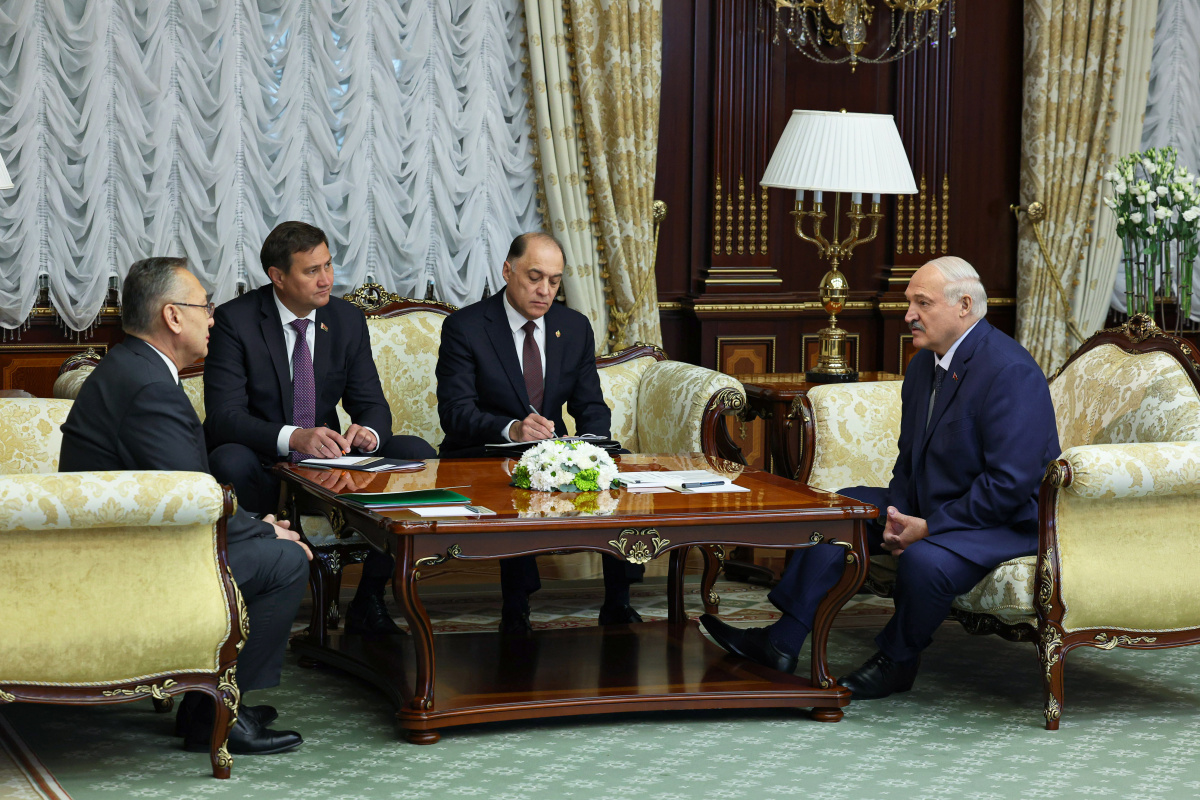
A meeting was held between CSTO Secretary General Talatbek Masadykov and President of Belarus Aleksandr Lukashenko
 06.04.2026
On 6 April 2026, a meeting was held in Minsk between CSTO Secretary General Talatbek Masadykov and President of the Republic of Belarus Aleksandr Lukashenko.
The parties held a detailed discussion on a wide range of international issues in the context of tasks related to strengthening security in the CSTO area of responsibility.
Talatbek Masadykov informed about the progress in implementing the Action Plan for the execution of decisions adopted at the November (2025) session of the CSTO Collective Security Council and the Organization’s priority areas of activity during Russia’s chairmanship. The document provides for active interaction among the member states across the full range of issues related to ensuring peace and stability in the Organization’s area of responsibility.
Among the key areas of joint work, the Secretary General highlighted preparations for upcoming meetings of the CSTO statutory bodies — the Council of Foreign Ministers, the Council of Defense Ministers and the Committee of Secretaries of Security Councils.
The Secretary General also informed about a series of large-scale joint exercises scheduled for the second half of the year, including “Indestructible Brotherhood”, “Interaction” and “Rubezh”, as well as special exercises “Cobalt” and “Skala”, and joint operations “Kanal”, “Mercenary” and “Illegal”.
Speaking about Belarus’ approaches to ensuring collective security, Aleksandr Lukashenko stated, in particular: “Belarus has always been a driving force in the development of relations within the CSTO and other structures in the former Soviet space. Our approaches are absolutely open. We conceal nothing and hide nothing. As for the CSTO, I proposed, long ago when the Organization was being formed (and even before that), a formula for action. We understand that Russia is the central element in this Organization. Everyone should clearly understand that, for example, in the western direction, Belarus is naturally the key element of the CSTO. And God forbid any conflict arises in this direction, Russia must always have here a core of armed forces that will join the Belarusian army in order to defend our common space.”
Addressing efforts to counter current challenges and threats, Talatbek Masadykov emphasized that special attention in the Organization’s activities is given to the development of analytical and forecasting components. “Amid the growing global crisis phenomena, we see an unconditional need for the most in-depth and objective analysis of the situation and for the development of appropriate recommendations. In this context, the Chairman of the CSTO Collective Security Council, President of Russia Vladimir Putin, has set the task of establishing a Eurasian Analytical Platform within the CSTO framework as a format for regular interaction among the expert and academic communities of the member states,” the CSTO Secretary General stated.