From October 18 to 23 this year, in accordance with the 2026 Plan for the Joint Training of Command and Control Bodies and Formations of Forces and Assets of the Collective Security System of the Collective Security Treaty Organization, the “Cobalt-2026” special exercise was held at the Magob training range of the Special Purpose Units Training Center of the Ministry of Internal Affairs of the Republic of Tajikistan.
An international scientific and practical conference entitled “Greater Eurasia: Institutions, Development, Cooperation” was held at the Moscow State Institute of International Relations (MGIMO) of the Russian Ministry of Foreign Affairs, jointly organized with the Institute of China and Contemporary Asia of the Russian Academy of Sciences (ICCA RAS). CSTO Secretary General Talatbek Masadykov took part in the conference.
A working meeting between CSTO Secretary General Talatbek Masadykov and Kazem Jalali, Ambassador Extraordinary and Plenipotentiary of the Islamic Republic of Iran to the Russian Federation, was held at the Embassy of the Islamic Republic of Iran in the Russian Federation.
An international scientific and practical conference entitled “Transformation of the Global Security System and the Shaping of a Eurasian Security Framework” was held at Moscow State Linguistic University (MSLU).
Today, a conference entitled “The Role and Place of Media in CSTO Member States in Efforts to Contain Crisis (Emergency) Situations in Collective Security Regions” was held in Minsk.
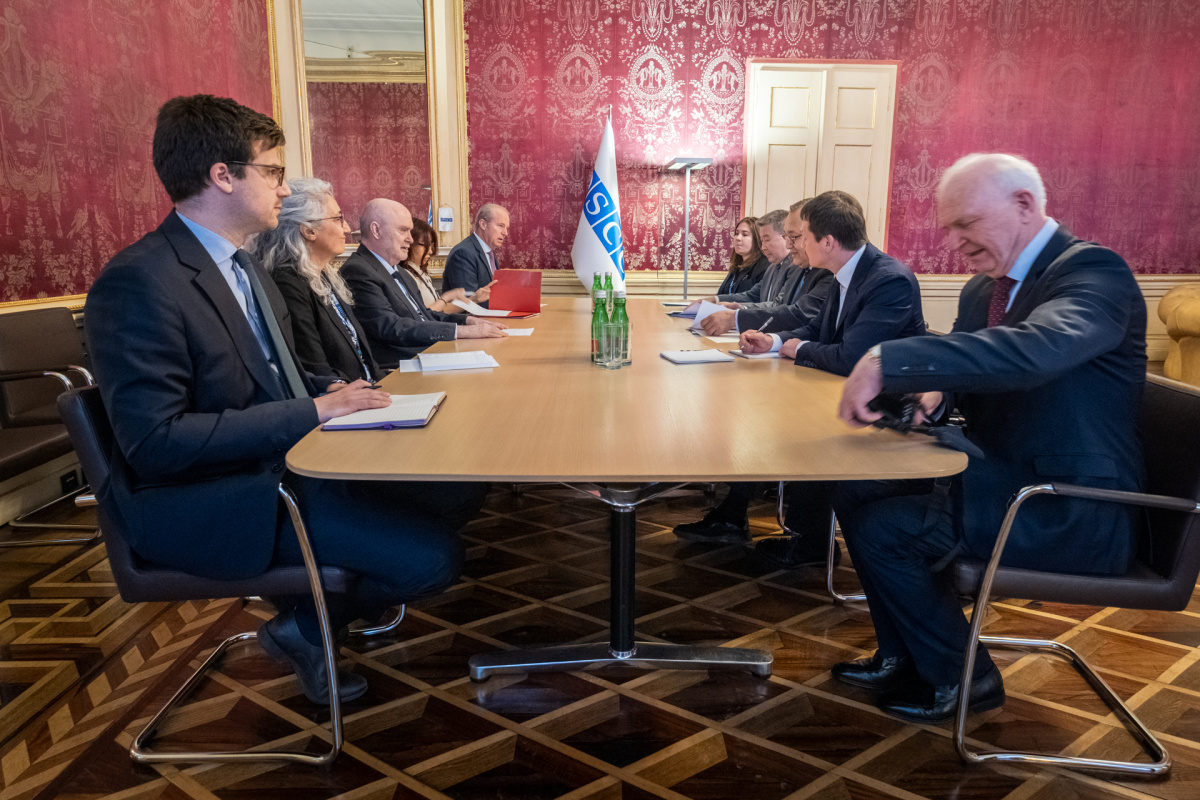
Meeting between the CSTO Secretary General Talatbek Masadykov and OSCE Secretary General Feridun Sinirlioğlu
 18.05.2026
On May 18, 2026, a meeting was held in Vienna between the CSTO Secretary General Talatbek Masadykov and OSCE Secretary General Feridun Sinirlioğlu.
The parties discussed a wide range of issues on the international agenda, with a focus on the security situation in Eurasia.
Special attention was paid to the role of regional organizations in ensuring sustainable political dialogue and adopting balanced decisions on security and cooperation issues. The significance of maintaining stable contacts between regional organizations in the interests of strengthening international peace and security in accordance with the provisions of Article 52 of Chapter VIII (“Regional Arrangements”) of the UN Charter was noted.
During the exchange of views on the situation in areas of mutual interest, the parties agreed that conflicts should be resolved by peaceful means through negotiations.
Regarding the Central Asian region, the importance of continuous monitoring of the impact of the “Afghan factor” on achieving sustainable peace and security in the region was emphasized. In this connection, Secretary General Talatbek Masadykov noted the active use of the capabilities of the Working Group on Afghanistan under the CSTO Council of Foreign Ministers, in which specialized structures of the UN, CIS and SCO participate on a permanent basis.
An agreement was reached to continue the expert dialogue between the Organization and the OSCE Secretariat, as well as other regional structures operating on the Eurasian continent, in the interests of international peace and security.