From October 18 to 23 this year, in accordance with the 2026 Plan for the Joint Training of Command and Control Bodies and Formations of Forces and Assets of the Collective Security System of the Collective Security Treaty Organization, the “Cobalt-2026” special exercise was held at the Magob training range of the Special Purpose Units Training Center of the Ministry of Internal Affairs of the Republic of Tajikistan.
An international scientific and practical conference entitled “Greater Eurasia: Institutions, Development, Cooperation” was held at the Moscow State Institute of International Relations (MGIMO) of the Russian Ministry of Foreign Affairs, jointly organized with the Institute of China and Contemporary Asia of the Russian Academy of Sciences (ICCA RAS). CSTO Secretary General Talatbek Masadykov took part in the conference.
A working meeting between CSTO Secretary General Talatbek Masadykov and Kazem Jalali, Ambassador Extraordinary and Plenipotentiary of the Islamic Republic of Iran to the Russian Federation, was held at the Embassy of the Islamic Republic of Iran in the Russian Federation.
An international scientific and practical conference entitled “Transformation of the Global Security System and the Shaping of a Eurasian Security Framework” was held at Moscow State Linguistic University (MSLU).
Today, a conference entitled “The Role and Place of Media in CSTO Member States in Efforts to Contain Crisis (Emergency) Situations in Collective Security Regions” was held in Minsk.
The International Scientific and Practical Conference “Contours of a New Architecture of Collective Security” was held at MGIMO University of the Ministry of Foreign Affairs of Russia
 27.04.2026
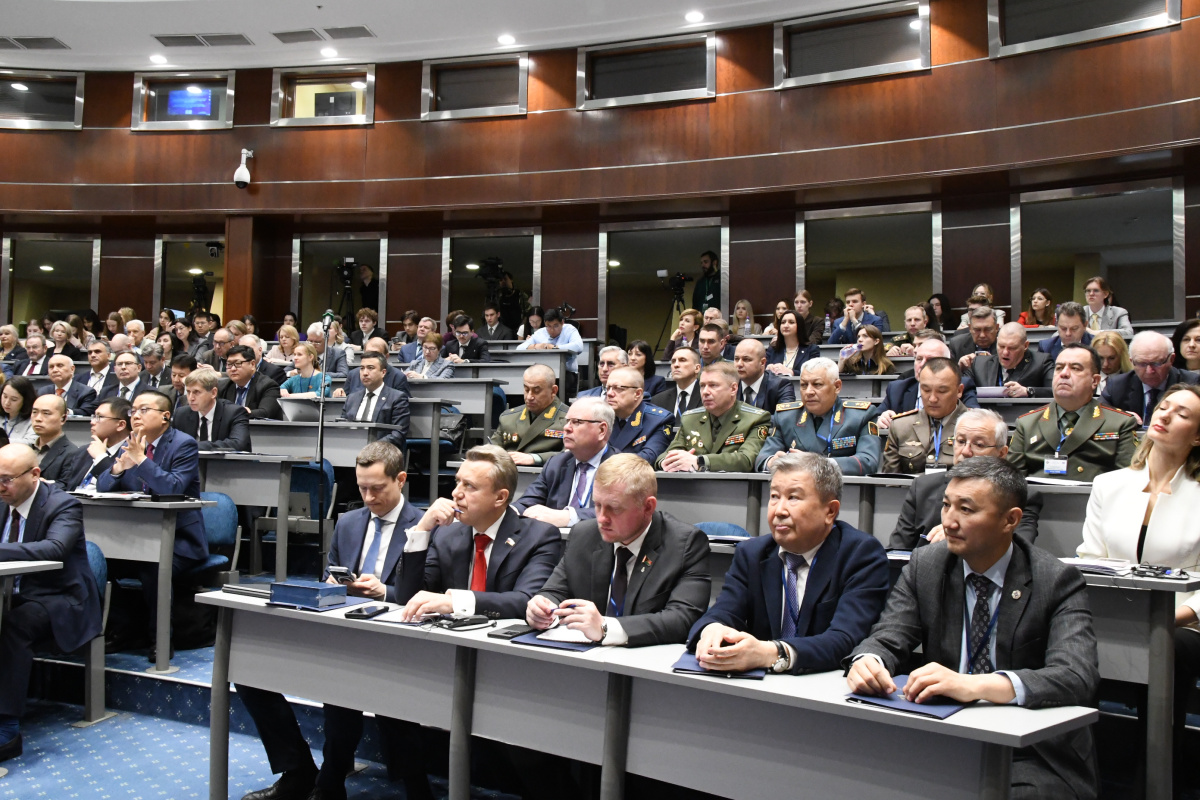
On 27 April 2026, the International Scientific and Practical Conference “Contours of a New Architecture of Collective Security: Current Issues of Information and Analytical Partnership within the CSTO,” organized by the CSTO Secretariat, was held at MGIMO University of the Ministry of Foreign Affairs of Russia. The event was attended by heads and representatives of international organizations, government bodies, diplomatic missions, as well as leading expert, educational and research institutions from the CSTO, CIS and SCO member states, including Russia, Belarus, Kazakhstan, Kyrgyzstan, Tajikistan, Uzbekistan, China and India.
The plenary session was moderated by Rector of MGIMO University Anatoly Torkunov. In his opening remarks, he emphasized that direct dialogue between international organizations and the expert and academic community is a key condition for shaping a new, sustainable architecture of collective security in Eurasia.
In his address, CSTO Secretary General Talatbek Masadykov noted that the April conference held under the auspices of the CSTO and partner organizations is becoming a traditional platform. He reported on the joint development of a proposal to establish a Eurasian Analytical Platform — a permanent system of expert dialogue using modern digital technologies and artificial intelligence for the implementation of joint projects.
CIS Executive Secretary Sergey Lebedev drew attention to the growing role of the CIS as a platform for aligning integration potentials. He stated that, amid the hybridization of threats and the crisis of international law, there is a need for close coordination among the analytical services of the CSTO, CIS and SCO, as well as for developing common approaches to information and analytical support for collective security.
The conference was also attended by Chief of the CSTO Joint Staff Colonel General Andrey Serdyukov.
During the plenary session and subsequent events — the working session “Integration Projects in Eurasia: Problems and Prospects for Cooperation in Ensuring Collective Security” and the round table “Eurasian Analytical Platform: New Approaches in a New Geopolitical Reality” — key issues of Eurasian security were discussed. Participants noted the irreversible nature of the emerging polycentric world order and the need to combine the potentials of the CSTO, CIS and SCO to ensure regional stability. They emphasized the importance of transitioning from a reactive security model to a cognitive one, based on joint expertise, forecasting and high-quality information and analytical support for decision-making.
Particular attention was paid to the Eurasian Analytical Platform project as a permanent digital system for dialogue between expert and academic communities and international organizations, the crisis of international security law, the hybridization of threats, and the need for a collective “Grand Strategy” for Eurasia.
Following the conference, an Address of the International Scientific and Practical Conference “Contours of a New Architecture of Collective Security: Current Issues of Information and Analytical Partnership within the CSTO” to the expert and academic communities of the CSTO, CIS and SCO member states was adopted.