On November 4, 2026, a working session entitled “The CSTO in Greater Eurasia: Current Status and Prospects” was held in Minsk as part of the 4th Minsk International Conference on Eurasian Security.
On November 3, 2026, the 4th Minsk International Conference on Eurasian Security was held in Minsk. The event was attended by President of the Republic of Belarus Alexander Lukashenko, Minister of Foreign Affairs of the Russian Federation Sergey Lavrov, CSTO Secretary General Talatbek Masadykov, CIS Secretary General Sergey Lebedev, SCO Secretary General Nurlan Yermekbayev, OSCE Secretary General Feridun Sinirlioğlu, representatives of the leadership of the foreign ministries of the Republic of Kazakhstan, the Kyrgyz Republic, the Republic of Tajikistan and a number of other states.
On October 30, 2026, the results of the “Channel-Caspian Lighthouse” subregional anti-drug operation were summed up as part of the implementation of the 2026 Plan of Key Activities of the Coordinating Council of Heads of Competent Drug Control Authorities of CSTO Member States (CCHCDCA).
From October 18 to 23 this year, in accordance with the 2026 Plan for the Joint Training of Command and Control Bodies and Formations of Forces and Assets of the Collective Security System of the Collective Security Treaty Organization, the “Cobalt-2026” special exercise was held at the Magob training range of the Special Purpose Units Training Center of the Ministry of Internal Affairs of the Republic of Tajikistan.
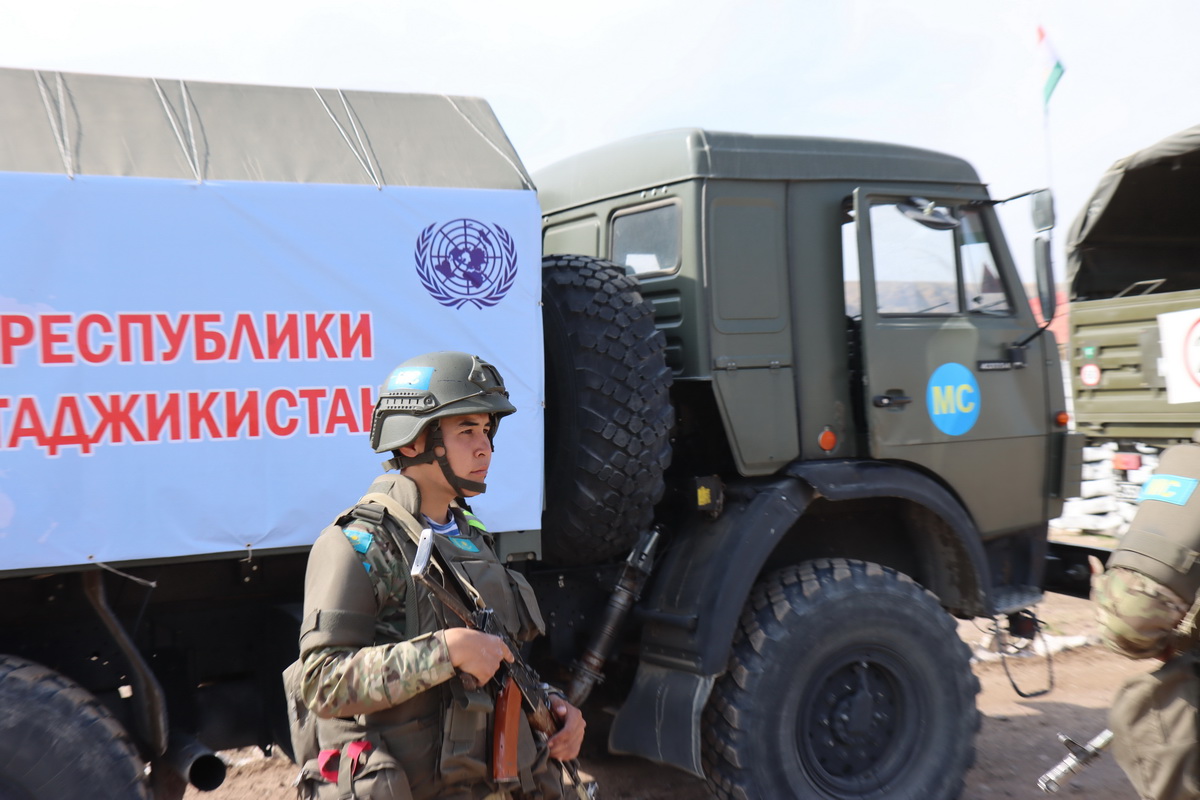
The CSTO Collective Peacekeeping Forces have delivered humanitarian supplies to the population
 03.10.2024
For the first time during the command-staff training “Indestructible Brotherhood-2024” the cargo parachute system APSDG-250 was used. The cargo parachutes of the system have a built-in navigation system that allows landing several cargo containers with landing accuracy up to one hundred meters from each other.
In Kazakhstan, during the “Indestructible Brotherhood-2024” command-staff training, the CSTO Collective Peacekeeping Forces practiced important post-conflict settlement tasks — the delivery of humanitarian supplies to the population.
The humanitarian cargoes included foodstuffs, including baby food, drinking water, medicines for various purposes, clothing, warm clothes and other necessities.
Delivery of humanitarian cargoes is organized by land transport. Guard units of the military contingents of the Kyrgyz Republic, the Russian Federation and the Republic of Tajikistan and specialized police vehicles were involved in escorting the convoys. Mi-35 attack helicopters of the Army Aviation carried out aerial reconnaissance tasks in the interests of delivering humanitarian aid and provided air cover for the actions of the escort units in the event of an attack on the convoy.
A number of vehicle convoys crossed the water obstacle using a pontoon crossing constructed in the shortest possible time by the engineering and demining units of the CSTO Collective Peacekeeping Forces.
Peacekeepers airlifted humanitarian supplies to hard-to-reach areas using aviation. The parachute-loading system PGS-500, which is in service with the Airborne Assault Troops of the Armed Forces of Kazakhstan, was used to drop the cargo. The system allows the cargo to be assembled in the shortest possible time and secretly dropped from a height of 4,000 meters.
In addition, the APSDG-250 cargo parachute system was used for the first time during the “Indestructible Brotherhood-2024” command-staff training. Its peculiarity is in automated control and high-precision landing of cargo in a given area from a height of up to 8,000 meters. Cargo parachutes have a built-in navigation system that allows landing several cargo containers with landing accuracy up to one hundred meters from each other.
A command-staff training with the CSTO Collective Peacekeeping Forces is being held at the “Bereg” training range of the Armed Forces of the Republic of Kazakhstan. National contingents of the peacekeeping forces of the Republic of Belarus, the Republic of Kazakhstan, the Kyrgyz Republic, Russia and the Republic of Tajikistan and operational groups of the CSTO Joint Staff and the CSTO Secretariat are taking part in the training. In total, the training involves more than 2,000 servicemen, 500 units of armored and motorized vehicles, Mi-17 and Mi-35 helicopters, Il-76 and Si-295 aircraft, and unmanned aviation.
The CSTO Joint Press Center CSTO of the training “Indestructible Brotherhood-2024”, the Republic of Kazakhstan, “Bereg” training range