From June 2 to 4, the Republic of Belarus hosted the second staff talks on the organization and conduct of the CSTO Peacekeeping Forces command-and-staff exercise “Indestructible Brotherhood 2026” and the special exercise “Barrier 2026” involving the CSTO Joint CBRN Protection and Medical Support Formation.
On June 3, 2026, a regular meeting of the CSTO Council of Defense Ministers (CDM) was held at the Patriot Central Park of the Russian Ministry of Defense under the chairmanship of the Russian side. The meeting was attended by CSTO Secretary General Talatbek Masadykov and Chief of the CSTO Joint Staff Andrey Serdyukov.
From June 1 to 3, Saratov (Russian Federation) is hosting a series of events involving the member states of the Collective Security Treaty Organization aimed at strengthening the collective response system to biological threats.
On June 1, 2026, consultations at the deputy foreign minister level of the CSTO member states were held in Moscow.
On May 28, 2026, CSTO Secretary General Talatbek Masadykov took part in the International Security Forum held under the auspices of the Security Council of the Russian Federation. More than 150 delegations from 120 countries participated in the event.
An extended meeting of the leadership of the CSTO Secretariat and Joint Staff was held
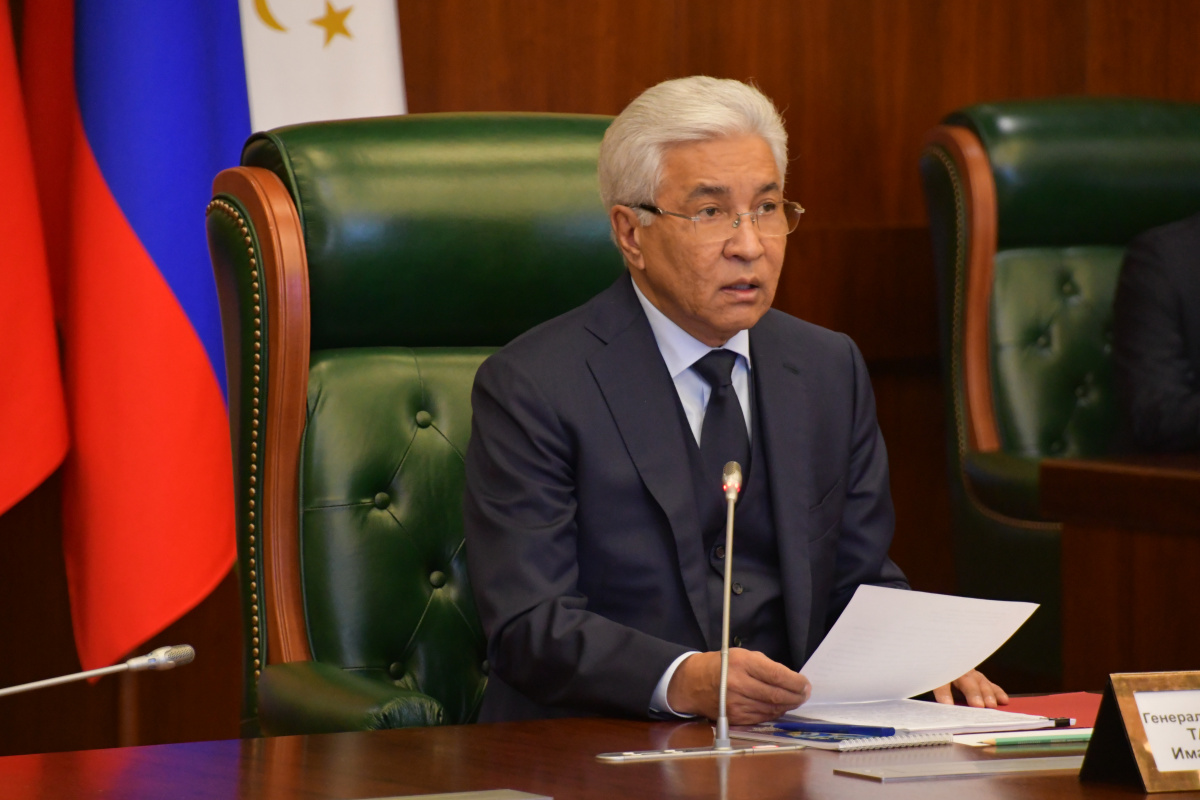 31.03.2023
On 31 March 2023, the CSTO Secretary General Imangali Tasmagambetov made a project report at an expanded meeting of the leadership of the CSTO working bodies. During his speech, a detailed assessment of the emerging geopolitical situation in the CSTO area of responsibility and adjacent regions was made, and approaches to ensuring peace and stability in the Organization's area of responsibility were formulated.
The Secretary General stressed that the current international situation was characterized by an increase in global and regional contradictions, which involved, among others, the CSTO member states.
In this context Imangali Tasmagambetov elaborated on the situation in the CSTO regions of collective security, stressing the presence of serious challenges and threats in each of them. Presenting the situation in Eastern Europe, the CSTO Secretary General stated the active involvement of extra-regional forces in the conflict in and around Ukraine. More and more advanced and powerful weapons systems are being supplied. There has been an unprecedented build-up of NATO military capabilities in the Baltic States, Poland and the Black Sea region.
According to the assessment of the CSTO Secretary General, the situation in the South Caucasus remains fraught with serious destabilization. The risks associated with the situation in Nagorno-Karabakh and on the Armenian-Azerbaijani border remain relevant.
In Central Asia, along with some positive developments related to the consensus reached by the countries of the region on border issues, the challenges and threats emanating from the territory of Afghanistan, where the positions of various terrorist groups and forces behind the illegal production and distribution of narcotic drugs are strengthened, remain very relevant.
The resolution of these crisis situations is complicated by the virtual breakdown of the system of international security treaties, as well as by the strongest sanctions and propaganda pressure exerted on the CSTO member states. Nevertheless, the nature of the challenges requires member states to take coordinated measures aimed at strengthening peace and stability in the Organization's area of responsibility.
Imangali Tasmagambetov has informed that the whole range of listed issues is in the focus of attention of political leadership of the Organization, which was confirmed during the meetings of Secretary General with the heads of the member states. At the same time, Imangali Tasmagambetov noted the unconditional commitment of the member states to the interests of collective security and the common determination to use the accumulated joint mechanisms to solve these and other problems. Furthermore, the Secretary General drew attention to the need to improve the CSTO activities, taking into account the changing international situation.
The meeting focused on tasks related to preparations for upcoming intersessional meetings of statutory bodies, as well as joint trainings and operations of the CSTO.