CSTO Secretary General Talatbek Masadykov expressed his condolences to Russian President Vladimir Putin following the crash of an An-12 military transport aircraft in the Kemerovo Region.
A working meeting between CSTO Secretary General Talatbek Masadykov and Igor Korotchenko, Director of the Caspian Institute for Strategic Studies (CISS) and Editor-in-Chief of the National Defense magazine, was held at the Secretariat of the Collective Security Treaty Organization (CSTO).
On November 12, 2026, the 22nd meeting of the Council of the Consultative Coordination Center of the Collective Security Treaty Organization for Responding to Computer Incidents (CSTO CCC) was held in Moscow. It was attended by delegations representing the national competent authorities of the Organization’s member states.
On November 11, 2026, a session of the CSTO Collective Security Council was held under the chairmanship of Russian President Vladimir Putin.
On November 11, 2026, a meeting was held at the Kremlin between CSTO Secretary General Talatbek Masadykov and President of the Russian Federation and Chairman of the CSTO Collective Security Council Vladimir Putin.
The Head of the Department for Countering Challenges and Threats of the CSTO Secretariat took part in the Annual Conference on the Review of Security Issues
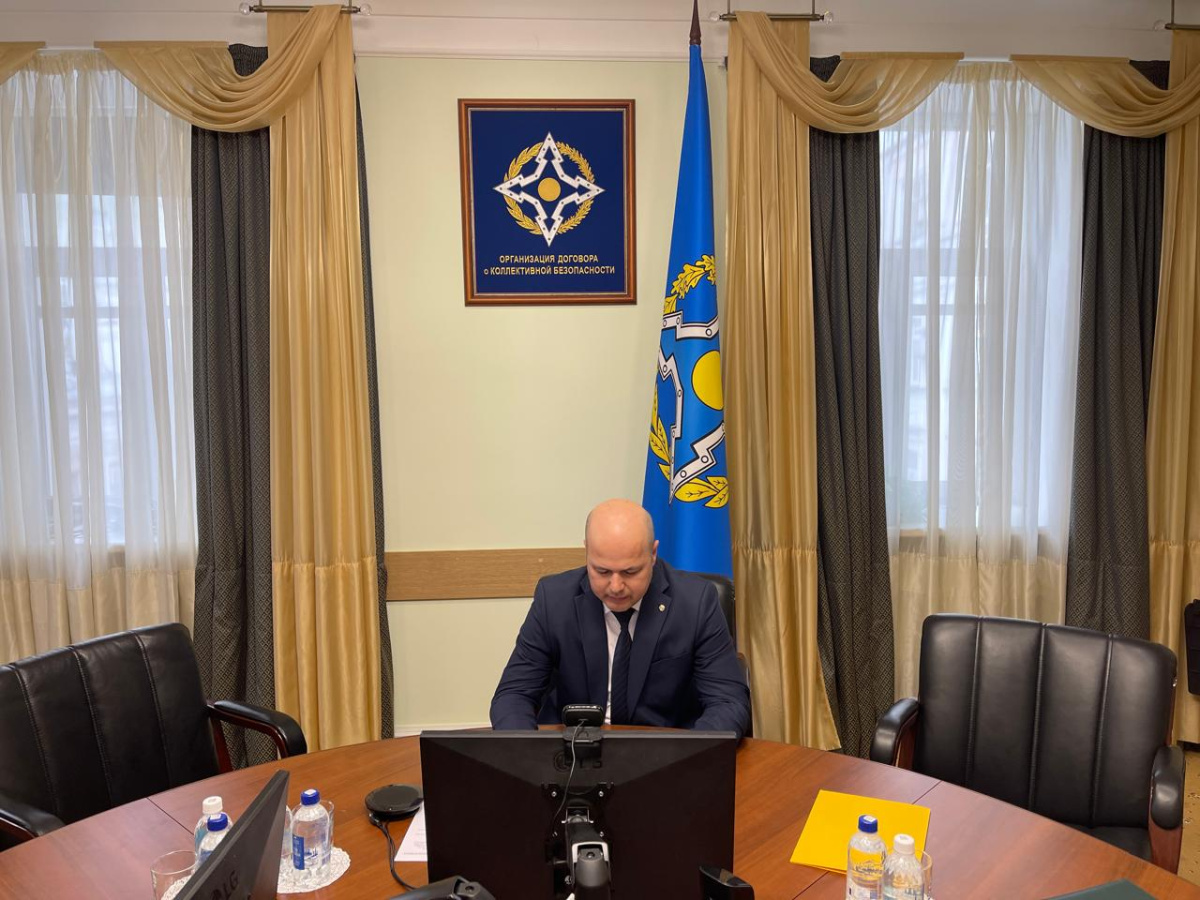 26.06.2025
Safar Umarzoda, Head of the Department for Countering Challenges and Threats of the CSTO Secretariat, took part in a special event (side-event) on "Countering Radicalization leading to terrorism and Extremism" organized by the Russian Federation on the margins of the OSCE Annual Conference on Security Review, where he reported on the measures taken by the CSTO on countering terrorism and extremism, and willingness to share the experience gained.
In his speech, Safar Umarzoda emphasized the global nature of the terrorist threat, which has intensified against the background of geopolitical turbulence. He emphasized the role of regional organizations, noting: "Strengthening regional stability... Regional organizations are able to form an alternative to inefficient or outdated models of relationships and create new, more effective security mechanisms." Practical measures of the CSTO were presented, including regular operations ("Channel", "PROXY", "Illegal", "Mercenary") aimed at suppressing channels of financing, recruitment and neutralizing the resource base of terrorism. The CSTO's readiness to share its accumulated experience, especially in the context of the Afghan crisis, was emphasized, and international and regional structures were called upon to actively cooperate.