On September 4 this year, a round table entitled “CSTO–SCO: Security Space” was held as part of the business program of the Eastern Economic Forum in Vladivostok. CSTO Secretariat representative Igor Panarin took part in the event.
On September 4, 2026, consultations on “Coordinating the positions of CSTO member states on the agenda of the UN General Assembly” were held in Moscow in accordance with the Plan of Consultations of Representatives of the Collective Security Treaty Organization Member States on Foreign Policy, Security and Defense for 2025–2027.
On September 4 this year, a round table entitled “CSTO–SCO: Security Space” was held as part of the business program of the Eastern Economic Forum in Vladivostok.
Today, a briefing was held by Colonel General Andrey Nikolaevich Serdyukov, Chief of the CSTO Joint Staff, on the topic “On the readiness of command and control bodies and formations of the CSTO collective security system forces and assets to conduct joint exercises.”
CSTO Secretary General Talatbek Masadykov holds a working meeting with Minister of Defense of the Kyrgyz Republic Ruslan Mukambetov
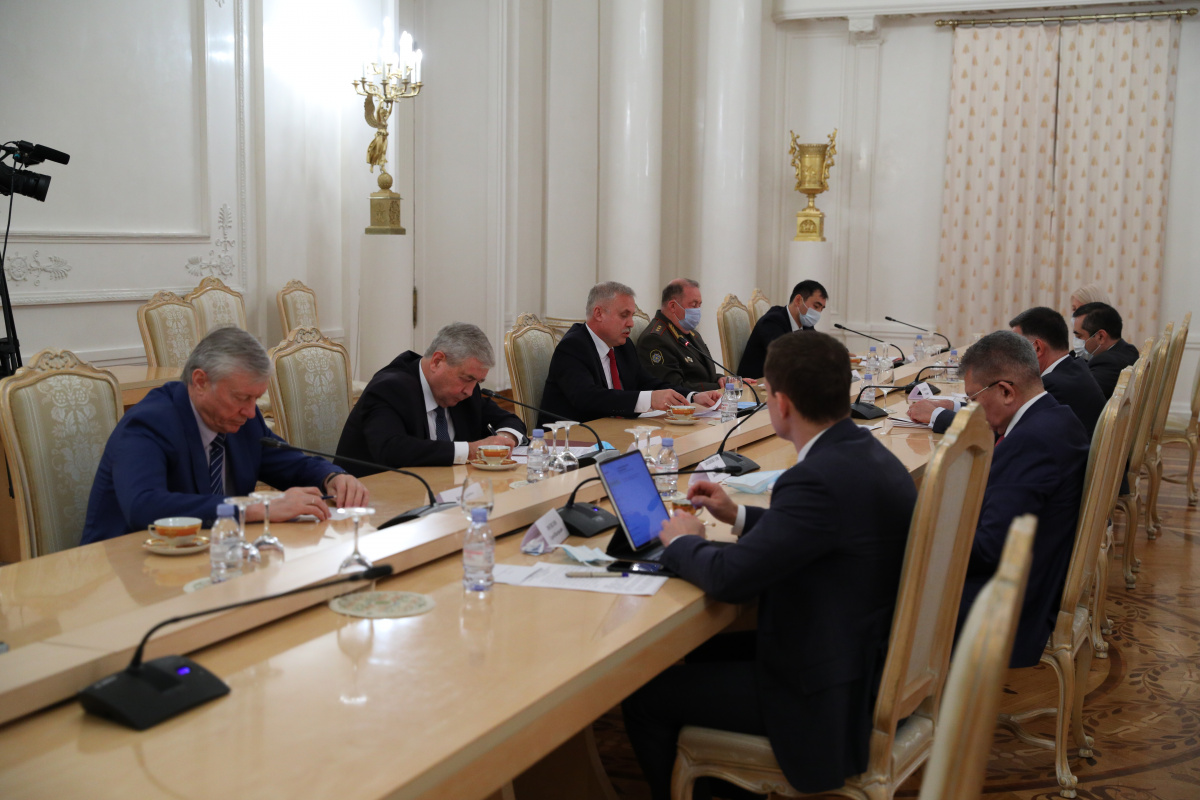
Statement of the CSTO Secretary General in the course of the “round table” meeting "CSTO: Landmarks for Strategic Development", October 7, 2020
 07.10.2020
October 7, 2020, Moscow
Dear colleagues!
To date, the Collective Security Treaty Organization has established as an effective international regional military-political structure:
– all the necessary regulatory legal framework has been developed;
– statutory and working bodies were created. Algorithms of their activities have been developed and their functioning has been adjusted;
– the appropriate assets have been formed, including the Collective Defense Forces. A system for their preparation and support has been built;
– a coordination system has been established in the foreign policy sphere and in other areas including joint counteraction to modern challenges and threats on an almost permanent basis (the operations "Channel", "Illegal", "Mercenary").
The CSTO is recognized by the UN and other international organizations as a subject of international politics. All these are the results of colossal joint efforts. Is that enough? Obviously it is not.
The realities of the current situation require us to develop the CSTO further in order to comprehensively improve the collective security system and increase its effectiveness. We must move forward, clearly seeing the landmarks for strategic development.
In part, these landmarks are laid down in the Collective Security Strategy until 2025. But for 5 years after its adoption, the military-political situation has changed. In addition, we definitely need to look into a more distant future.
One of these landmarks is the expansion of foreign policy activities, strengthening of cooperation with international organizations and interested countries.
In this context, we note with satisfaction the distribution on the opening day of the 75th session of the UN General Assembly of the Joint Statement of the UN and the CSTO Secretaries General in connection with the 10th anniversary of the signing of the Joint Declaration on Cooperation between the Secretariats of the UN and the CSTO. The Joint Statement reaffirmed its intention to further increase the scale of cooperation at all levels.
We manage to maintain a high level of relations both with the UN and the OSCE, and with the CIS and SCO. As you know, the CSTO CFM meeting held on May 26, this year, was attended by the Chairman of the Executive Committee – the CIS Executive Secretary Lebedev S.N. and the SCO Secretary General Norov V.I.
We hope that the CSTO member states will soon complete the process of ratification of the Third Protocol on amending the CSTO Charter, which provides for the participation of other states in the activities of the Organization as partners and observers. This will create additional opportunities for expanding the circle of international communication of the CSTO and will lay the foundation for the possibility of bringing our interaction with a number of countries and international organizations to a qualitatively higher level.
It is also necessary to further develop the components of the CSTO Collective Forces, increase their mobility and readiness to perform earmarked tasks. In this regard, the task of forming united military systems, of the CSTO comes to the fore, and above all the integration of regional air defense systems into the CSTO Unified Air Defense System. We consider it important to continue work on the regulatory legalization of issues, the Acquisition, Technology, and Logistics support of the CSTO Troops (Collective Forces) and the creation of stocks of material resources. A further landmark is the creation of multinational connections.
The development of the CSTO peacekeeping potential will continue to be an important area. Today, all the necessary prerequisites have been created for the further involvement of the Organization's Peacekeeping Forces in the relevant UN missions.
The main promising task in the field of military-economic cooperation is the development of practical multilateral interaction of the military-industrial complexes of the CSTO member states for the joint development and production of modern weapons, military equipment and other military products, the creation of a regional service network for their repair and maintenance.
In the interests of increasing the efficiency of the system of responding to modern challenges and threats, the capacity of the CSTO member states to counter terrorism, extremism, drug trafficking and illegal migration will continue to be strengthened.
In this regard, a promising direction is the implementation of the idea of synchronizing anti-terrorist measures implemented in the formats of the CSTO, the SCO and the CIS, voiced at the CSTO Ministerial Council meeting in May of this year.
It is also planned to focus efforts on proactive analytical identification of new threats caused by the use of modern information and communication technologies for criminal purposes, including "artificial intelligence", the "5G" system and others.
The problem of biological safety requires understanding. The ongoing coronavirus pandemic has had a negative impact on all aspects of international, political and socio-economic activity. Probably, the spread of this, and possibly new infections, will remain for a long time a source of security threats not only in the CSTO space, but also for the world community as a whole.
In conclusion, I would like to emphasize that we have sufficient potential for the progressive development of the CSTO. Now and in the future, the Organization will be able to provide a guaranteed response to emerging challenges and threats.
Thank you for attention.