An international scientific and practical conference entitled “Transformation of the Global Security System and the Shaping of a Eurasian Security Framework” was held at Moscow State Linguistic University (MSLU).
Today, a conference entitled “The Role and Place of Media in CSTO Member States in Efforts to Contain Crisis (Emergency) Situations in Collective Security Regions” was held in Minsk.
An international scientific and practical conference entitled “The Situation in the Middle East, North Africa and the Sahara-Sahel Region: Development Forecasts for 2027” was held in Moscow, organized by the Center for Scientific and Analytical Information of the Institute of Oriental Studies of the Russian Academy of Sciences.
On October 18, 2026, the “Cobalt-2026” special exercise opened in the Republic of Tajikistan, in accordance with the 2026 Plan for the Joint Training of Command and Control Bodies and Formations of Forces and Assets of the CSTO Collective Security System. The exercise involves special units of internal affairs and national security agencies, internal troops (National Guard), special services and anti-drug agencies, as well as rescue units incorporated into the Special Purpose Forces formations of the CSTO Collective Operational Reaction Forces (CORF).
From October 13 to 16, 2025, the 23rd International Combat Sambo Tournament for the Cup of the Secretary General of the Collective Security Treaty Organization, featuring law enforcement personnel from CSTO member states, was held at the Ognikovo Park Hotel (19 Ognikovo, Istra District, Moscow Region).
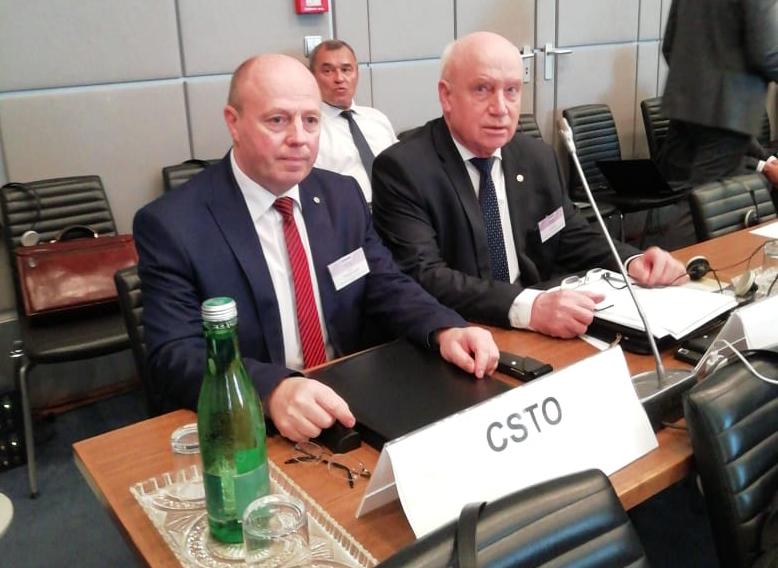
The CSTO Deputy Secretary General Piotr Tsikhanouski took part in the OSCE Annual Security Review Conference, which was held in Vienna from June 25-27
 27.06.2019
On June 25 - 27 of this year the regular OSCE Annual Security Review Conference was held in Vienna. This year, its theme was defined as “In the name of people, dialogue and stability - strengthening comprehensive security in the OSCE region”.
The meeting brought together representatives of diplomatic departments and research centers of the majority of 57 states participating in this largest regional international organization and 11 states of its partners, as well as officials of relevant international organizations to discuss topical issues and challenges in the field of security and the role that the OSCE could play to overcome that problems.
The conference was opened by the OSCE Chairperson-in-Office Slovak Minister of Foreign and European Affairs Miroslav Lajčák. Then, in the course of six meetings, the participants thoroughly discussed various aspects of security and stability in the region. The delegation of the Secretariat of the Collective Security Treaty Organization headed by its Deputy Secretary General Piotr Tsikhanouski took an active part in the work of the Conference.
The head of the CSTO delegation spoke at a meeting on the control of non-nuclear weapons and confidence- and security-building measures, stating with concern that the military-political situation in the OSCE region continues to evolve in a negative scenario. In this regard, he drew the attention of the Conference participants to the Open Appeal to the Ministers of Foreign Affairs of the Member States of the North Atlantic Treaty Organization on Strengthening Mutual Confidence and Development of Cooperation, adopted by the Council of Ministers of Foreign Affairs of the CSTO on May 22, 2019. Recalling the content of the document, in which the ministers, guided by the provisions of the OSCE Security Platform, call on the heads of diplomatic departments of NATO member states to take a number of concrete joint steps as a matter of priority, Piotr Tsikhanouski asked his colleagues to help start such a constructive dialogue.
The CSTO Deputy Secretary General also spoke at a meeting on transnational threats. He informed the participants of the meeting about the painstaking daily work carried out in the Organization’s format in the priority direction for it to combat all types of contemporary challenges and threats, including terrorism and related extremism, drug and arms trafficking, cross-border organized crime, illegal migration, the use of information telecommunications technology for criminal purposes. The successful development of cooperation in resolving these tasks between the CSTO and the OSCE, the needs for further efforts to create a broad antiterrorist front of all international and regional specialized organizations with a central coordinating role of the UN was noted.
Interviews on the Conference confirmed the growing understanding in the international expert community of this consistently conducted CSTO line, the prospects of the Organization’s efforts to improve the dialogue aimed at strengthening security and stability in the region at the OSCE sites.