From October 18 to 23 this year, in accordance with the 2026 Plan for the Joint Training of Command and Control Bodies and Formations of Forces and Assets of the Collective Security System of the Collective Security Treaty Organization, the “Cobalt-2026” special exercise was held at the Magob training range of the Special Purpose Units Training Center of the Ministry of Internal Affairs of the Republic of Tajikistan.
An international scientific and practical conference entitled “Greater Eurasia: Institutions, Development, Cooperation” was held at the Moscow State Institute of International Relations (MGIMO) of the Russian Ministry of Foreign Affairs, jointly organized with the Institute of China and Contemporary Asia of the Russian Academy of Sciences (ICCA RAS). CSTO Secretary General Talatbek Masadykov took part in the conference.
A working meeting between CSTO Secretary General Talatbek Masadykov and Kazem Jalali, Ambassador Extraordinary and Plenipotentiary of the Islamic Republic of Iran to the Russian Federation, was held at the Embassy of the Islamic Republic of Iran in the Russian Federation.
An international scientific and practical conference entitled “Transformation of the Global Security System and the Shaping of a Eurasian Security Framework” was held at Moscow State Linguistic University (MSLU).
Today, a conference entitled “The Role and Place of Media in CSTO Member States in Efforts to Contain Crisis (Emergency) Situations in Collective Security Regions” was held in Minsk.
The presentation of the Eurasian Analytical Platform was held at the CSTO Conference at MGIMO University of the Ministry of Foreign Affairs of Russia
 27.04.2026
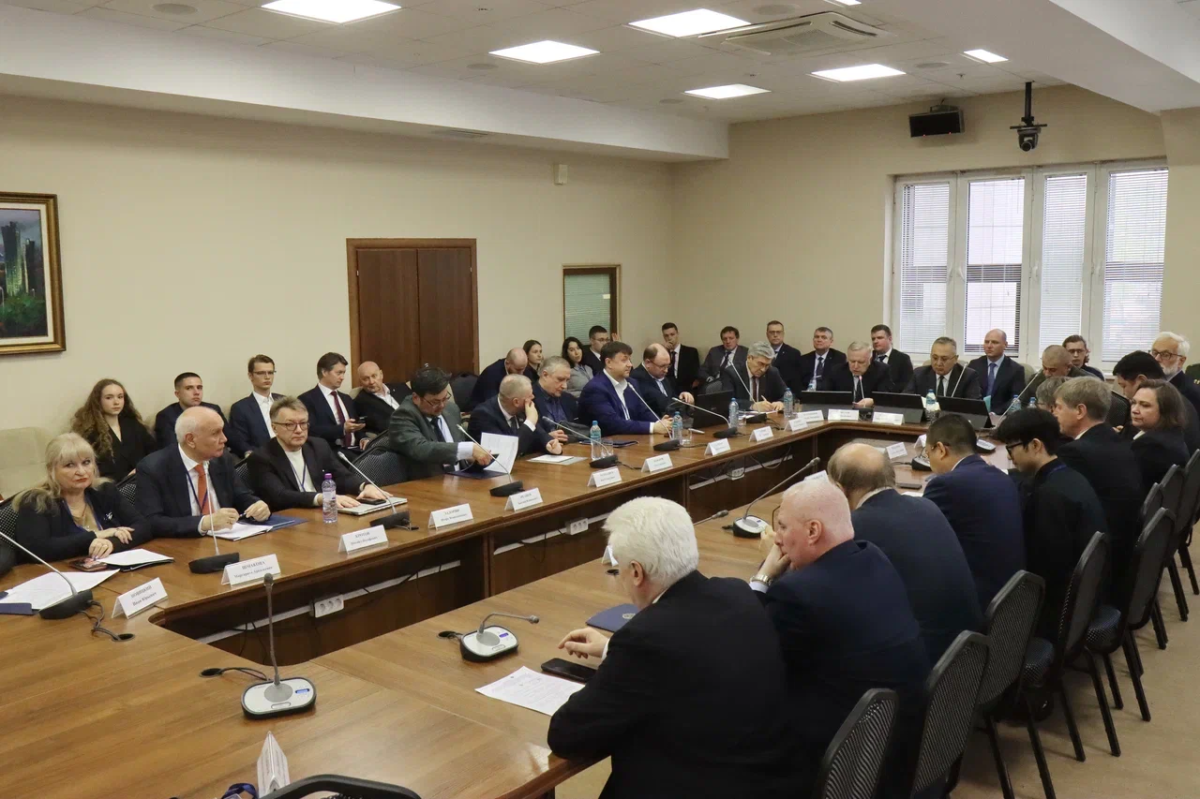
On 27 April 2026, within the framework of the International Scientific and Practical Conference “Contours of a New Architecture of Collective Security: Current Issues of Information and Analytical Partnership within the CSTO,” held at MGIMO University of the Ministry of Foreign Affairs of Russia, a round table entitled “Eurasian Analytical Platform: New Approaches in a New Geopolitical Reality” took place. During the event, Head of the Information and Public Relations Department of the CSTO Secretariat Yuriy Shuvalov delivered a presentation on “The Eurasian Analytical Network: A New Cognitive Architecture of Collective Security.”
Yuriy Shuvalov, in particular, noted:
“We live in a world where the speed of emerging threats outpaces the capabilities of traditional response mechanisms. Military, financial and economic threats, cyberattacks, information operations and hybrid crises are changing the very nature of security.
Security activity is increasingly becoming cognitive in nature: analysis, forecasting, scenario modeling, identification of hidden interconnections, and early warning. Even purely military potential today directly depends on the quality of cognitive work. Without a unified, continuously functioning expert environment, CSTO member states risk acting with significant time delays. That is why the systematic collection, comparison and processing of national expert assessments, as well as the development of scenarios and response options, are of critical importance.
Traditional mechanisms respond to already manifested threats. However, modern challenges often arise at the intersection of different domains — the economy, finance, cyberspace, migration, climate and environmental issues.
An expert and analytical network would enable early identification of threats and risks — at the stage of ‘weak signals.’ This would be followed by scenario modeling and the preparation of alternative solutions. Such an approach makes it possible to act proactively rather than reactively.
This work should be based on an effective network structure comprising a coordination center, national nodes, thematic working groups and a digital platform. This would create a ‘pipeline’ from requests of governing bodies to consolidated analytical documents and monitoring of implementation. This represents a well-balanced response both to existing and emerging threats.
The CSTO brings together states with different geopolitical positions, economic models, and cultural and legal traditions. What may be perceived as a threat by one country may be seen as an acceptable risk by another.
The establishment of an expert and analytical network would not aim to unify opinions, but to compare them within a common methodology. National nodes would provide their perspectives, thematic groups would align them, identify possible differences, and produce a consolidated yet balanced outcome that reflects the full spectrum of positions.
This is particularly important for collective security: compromise is achieved not through political bargaining, but at the stage of expert analysis. The network thus becomes a bridge between different perceptions of threats.
The proposed CSTO Expert and Analytical Network is not a closed, self-sufficient structure. Its architecture (coordination center, national nodes, thematic groups and digital platform) should be designed from the outset as open and scalable.
We are convinced that the CSTO Expert and Analytical Network could become the core of a broader Eurasian analytical network involving interested CIS countries, and potentially include a number of SCO member states.
Why is this realistic?
• Thematic working groups on terrorism, information security, migration and security economics address issues relevant across the Eurasian space.
• A unified digital platform, using artificial intelligence technologies and an expert registry, would allow specialists from different countries to be integrated without creating parallel structures.
Thus, a prototype of a pan-Eurasian expert and analytical infrastructure for the future is being created.
Dear colleagues, we propose a paradigm shift: from reactive to cognitive security, from fragmented assessments to comparable expertise, and from national perspectives to a collective vision of the future.
The CSTO Expert and Analytical Network can become the ‘brain’ that enables us to identify threats earlier, respond more precisely, and act together — despite the diversity of our approaches and interests.”