On November 4, 2026, a working session entitled “The CSTO in Greater Eurasia: Current Status and Prospects” was held in Minsk as part of the 4th Minsk International Conference on Eurasian Security.
On November 3, 2026, the 4th Minsk International Conference on Eurasian Security was held in Minsk. The event was attended by President of the Republic of Belarus Alexander Lukashenko, Minister of Foreign Affairs of the Russian Federation Sergey Lavrov, CSTO Secretary General Talatbek Masadykov, CIS Secretary General Sergey Lebedev, SCO Secretary General Nurlan Yermekbayev, OSCE Secretary General Feridun Sinirlioğlu, representatives of the leadership of the foreign ministries of the Republic of Kazakhstan, the Kyrgyz Republic, the Republic of Tajikistan and a number of other states.
On October 30, 2026, the results of the “Channel-Caspian Lighthouse” subregional anti-drug operation were summed up as part of the implementation of the 2026 Plan of Key Activities of the Coordinating Council of Heads of Competent Drug Control Authorities of CSTO Member States (CCHCDCA).
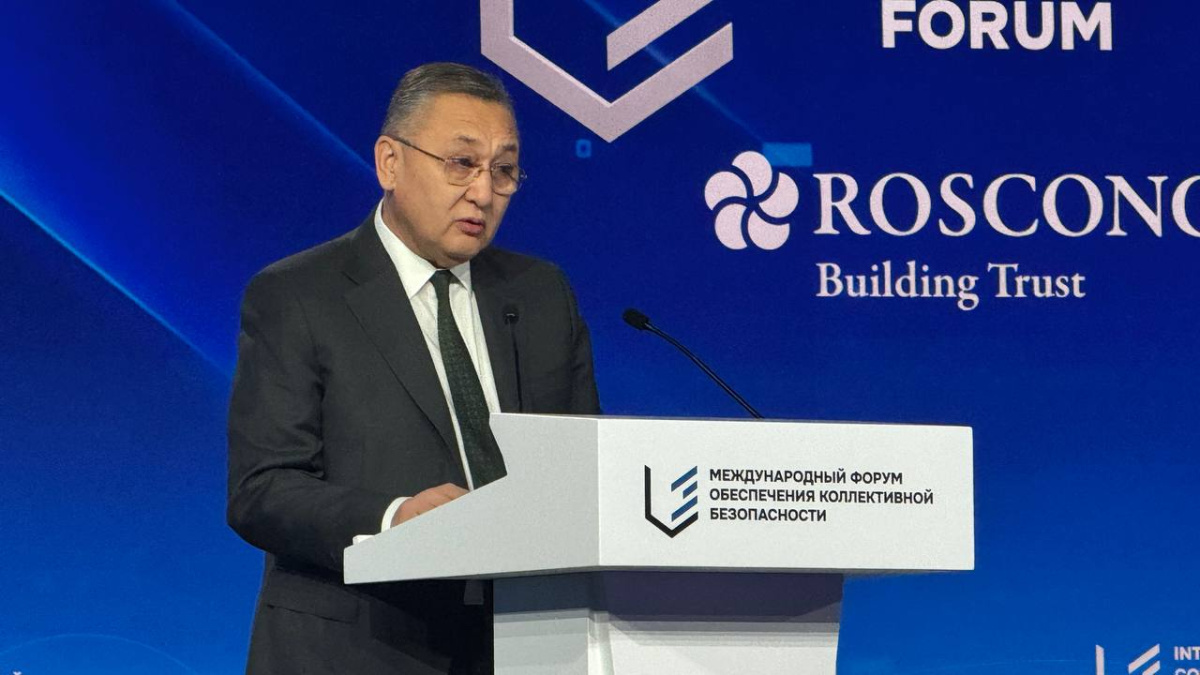
CSTO Secretary General Talatbek Masadykov takes part in the plenary session of the International Forum on Collective Security
 10.11.2026
On November 10, 2026, a plenary session of the International Forum on Collective Security was held in Moscow. It was attended by CSTO Secretary General Talatbek Masadykov; Belarusian Foreign Minister Maxim Ryzhenkov; Kazakh Foreign Minister Mukhtar Tleuberdi; Kyrgyz Foreign Minister Jeenbek Kulubaev; Russian Foreign Minister Sergey Lavrov; and Tajik Foreign Minister Sirojiddin Muhriddin.
The participants exchanged views on a wide range of issues related to Eurasian security.
Key points of the address by CSTO Secretary General Talatbek Masadykov:
Dear Alexey Loginovich,
Distinguished Forum participants, ladies and gentlemen,
I would like to express my sincere gratitude to the Russian Chairmanship for the excellent organization of such a high-level and representative Forum. It is a great honor and privilege for me to speak on issues related to ensuring collective security.
There is no doubt that today's event will contribute to a successful and constructive discussion of pressing international security and defence issues.
This conference is being held against the backdrop of two anniversaries of global historical significance: the 85th anniversary of the beginning of the Great Patriotic War and the 80th anniversary of the Judgment of the International Military Tribunal at Nuremberg. These dates are indelibly etched in the memory of our peoples.
The unifying motto of the Russian CSTO Chairmanship — “Collective Security in a Multipolar World: A Common Goal, Shared Responsibility” — together with its ambitious and timely priorities, has enabled us to significantly intensify our work. We are carrying it out under challenging circumstances.
Profound geopolitical changes are taking place around the world. The emergence of a polycentric world order is accompanied by mounting contradictions and, consequently, an expansion in the scale of international conflicts, as well as high volatility and unpredictability. Instability is spreading across virtually all spheres of political, socio-economic and public relations. The use of traditional political and diplomatic instruments and mechanisms has become more difficult, while established methods of settlement within the UN framework are increasingly being replaced by the “might makes right” principle, awkwardly disguised by the formula of the so-called “rules-based order”.
We are witnessing an unprecedented surge in global military spending and the militarization of the economies of the countries of the “collective West”. With strategic stability at a critically low level, there are no international legal constraints on the development of nuclear arsenals or the creation of new lethal and destructive weapons of mass destruction.
Outer space is increasingly viewed as an arena for deploying offensive weapons. Space commands are being established to coordinate and conduct military operations in near-Earth space. Moreover, space assets originally declared to be civilian are now being actively used for military purposes, including surveillance, reconnaissance, targeting and secure communications.
A new arms race has spread to the military application of artificial intelligence, including in lethal autonomous systems. The legal vacuum in this area and the absence of any international legal instruments regulating the use of such systems create a risk of escalating conflicts. Of particular concern is the potential access of international terrorist organizations and transnational criminal groups to cutting-edge technologies.
Biological and chemical security threats persist and require a coordinated multilateral response. However, the development of agreed measures is significantly complicated by the politicization by a number of Western countries of the activities of established international legal regimes — the Conventions on the Prohibition of Biological and Chemical Weapons.
Information and communication technologies are actively being used to interfere in the internal affairs of sovereign states. At the same time, proxy warfare methods employed in geopolitical rivalry are compounded by traditional and emerging security challenges and threats. International terrorist organizations, transnational criminal groups and drug cartels continue to pose security challenges, including in the CSTO area of responsibility.
Distinguished Forum participants,
Growing confrontation at the global and regional levels, the renewed arms race and the emergence of fundamentally new military technologies are accompanied by the growing proximity of “hotbeds of instability” to the CSTO area of responsibility.
The threat of an escalation of the military confrontation between the United States and Israel on the one hand and Iran on the other remains. This is taking place in the immediate vicinity of the CSTO’s borders and entails risks that could have serious consequences.
The situation is becoming unprecedentedly tense due to the intentions of certain NATO members to deploy nuclear arsenals and their delivery systems near the western borders of the Eastern European Collective Security Region. The implementation of such plans would have far-reaching consequences for the security of Central and Eastern Europe.
The turbulent process of restructuring international relations is increasing the role and importance of regional security organizations. The CSTO undoubtedly occupies one of the key positions among them. This is not, of course, a matter of geography, but of our collective capabilities and accumulated experience in cooperation across a wide range of issues. We are ready to share this experience and develop contacts with other international organizations.
Together with our colleagues from the CIS, SCO, CICA and other regional organizations, the CSTO pays close attention to monitoring complex political processes across Eurasia. Whenever possible, we actively work to eliminate threats to collective security at the earliest stage of their emergence. The main contributions the CSTO makes to these efforts are preventive diplomacy, continuous counter-terrorism activities and efforts to combat drug trafficking, as well as ensuring international information security.
As we approach the 35th anniversary of the signing of the Collective Security Treaty and the 25th anniversary of the establishment of the CSTO, we are pleased to note the positive results of our joint work. Against the backdrop of the growing role of Greater Eurasia as a whole in the emerging multipolar world, Central Asia serves as an example of constructive interstate cooperation and is becoming a model of stability and dynamic development. Thanks to the political will and consistent efforts of the leaders of Central Asian states, border disputes have become a thing of the past. A spirit of partnership and cooperation is becoming the foundation for the peaceful resolution of long-standing interstate problems.
Certain changes are also taking place in the Afghan direction. The successful intensification of bilateral contacts with the authorities in Kabul, together with the policy of comprehensive cooperation and assistance to the people of Afghanistan pursued by a number of CSTO member states, is helping the country's socio-economic development. The CSTO Secretariat contributes to coordinating these efforts through the Working Group on Afghanistan under the CSTO Council of Foreign Ministers.
We continue to give unwavering priority to the goal of collectively countering transboundary threats. We regard the implementation of the Targeted Interstate Programme to Strengthen the Tajik-Afghan Border as a fundamental task in ensuring collective security. All our allies have begun active work on its implementation. We are confident that Afghanistan's long-term stability, which is in the interests of all its neighbors, is inseparable from the security and sustainable development of Central Asia.
The positive changes achieved in recent years in ensuring peace and security in the region have strengthened the objective need to establish a Eurasian security system based on new principles. These include the indivisibility of security, the rejection of double standards, respect for the diversity and equality of all states, inclusiveness and compliance with international law. Security cooperation must be underpinned by the development of multifaceted ties in the economy, culture and other areas, based on openness, broad engagement and mutual benefit.
These are precisely the approaches underpinning the initiative of the Republic of Belarus and the Russian Federation to develop a “Eurasian Charter of Diversity and Multipolarity in the 21st Century”, which has been supported by our CSTO allies. In September 2026, on the sidelines of the 81st session of the UN General Assembly, the negotiation process on drafting such a document was launched. Its purpose is not to produce yet another declaration, but to establish the conceptual foundations for a new architecture of security and cooperation on the continent. It is important to emphasize that the Charter is not directed against anyone; rather, it is conceived as a unifying process open to all states of our shared continent. Eurasian security is common and indivisible, and no country can ensure it on its own.
It is clear that all regional organizations of Eurasian states will have a role to play in implementing this ambitious task, which serves the interests of all countries on the continent. Each of them, within the scope of its mandate, is committed to ensuring peace and security and promoting sustainable development.
As for the CSTO, we intend to continue working to consolidate the Organization's role as a significant stabilizing factor and an effective military-political structure in Greater Eurasia, committed to maintaining lasting peace and stability in its area of responsibility. The Organization has everything it needs to achieve this.
Distinguished Forum participants,
We are open to dialogue with everyone and to cooperation with those who share our principles and goals and are ready to take practical steps to ensure sustainable socio-economic prosperity in the region.
I wish you all a productive conference.
Thank you for your attention.