On November 19, 2026, the 28th meeting of the Coordination Council of Heads of Competent Drug Control Authorities of the Member States of the Collective Security Treaty Organization (hereinafter referred to as the Coordination Council or the CSTO CCHCDCA) was held in Kazan as part of the Russian Federation’s chairmanship of the CSTO.
CSTO Secretary General Talatbek Masadykov expressed his condolences to Russian President Vladimir Putin following the crash of an An-12 military transport aircraft in the Kemerovo Region.
A working meeting between CSTO Secretary General Talatbek Masadykov and Igor Korotchenko, Director of the Caspian Institute for Strategic Studies (CISS) and Editor-in-Chief of the National Defense magazine, was held at the Secretariat of the Collective Security Treaty Organization (CSTO).
On November 12, 2026, the 22nd meeting of the Council of the Consultative Coordination Center of the Collective Security Treaty Organization for Responding to Computer Incidents (CSTO CCC) was held in Moscow. It was attended by delegations representing the national competent authorities of the Organization’s member states.
On November 11, 2026, a session of the CSTO Collective Security Council was held under the chairmanship of Russian President Vladimir Putin.
CSTO Secretary General Talatbek Masadykov takes part in the 4th Minsk International Conference on Eurasian Security
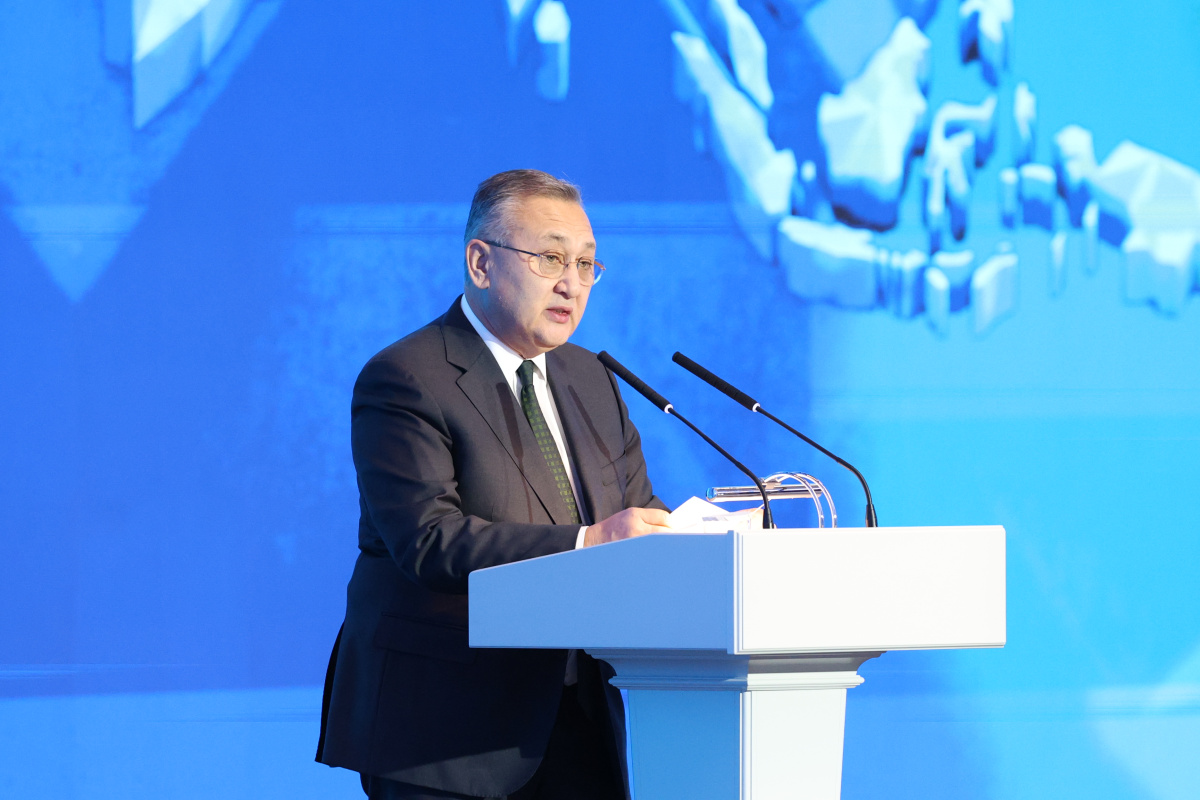 03.11.2026
On November 3, 2026, the 4th Minsk International Conference on Eurasian Security was held in Minsk. The event was attended by President of the Republic of Belarus Alexander Lukashenko, Minister of Foreign Affairs of the Russian Federation Sergey Lavrov, CSTO Secretary General Talatbek Masadykov, CIS Secretary General Sergey Lebedev, SCO Secretary General Nurlan Yermekbayev, OSCE Secretary General Feridun Sinirlioğlu, representatives of the leadership of the foreign ministries of the Republic of Kazakhstan, the Kyrgyz Republic, the Republic of Tajikistan and a number of other states.
Participants held a thorough exchange of views on a wide range of current Eurasian and global political and security issues.
Key points of the address by CSTO Secretary General Talatbek Masadykov:
Dear participants of the conference,
It is a great honor and privilege for me to address the 4th Minsk Conference on Eurasian Security.
Over the years, this forum has established itself as a respected international platform for exchanging views on pressing issues of world politics.
I am grateful to our Belarusian friends for the excellent organization of this event.
Developments have fully confirmed the assessments of the global geopolitical situation voiced in Minsk in previous years, namely that strategic instability is on the rise.
At the CSTO Secretariat, we are observing an intensification of regional conflicts and the advance of “zones of instability” towards the borders of our Organization.
These negative processes are unfolding against the backdrop of an objective transition from unipolar dominance to a polycentric system of international relations. This transition is accompanied by growing confrontation at the global and regional levels and an escalation of the entire range of challenges and threats to international security. The arms race is once again gathering momentum, while fundamentally new military technologies are emerging.
The use of force is becoming increasingly prominent in world politics. We are witnessing an unprecedented surge in global military spending and the militarization of economies. Total military expenditure has been rising continuously for the past 11 years and could exceed USD 3 trillion in 2026.
The sharp decline in strategic stability is a matter of particular concern. Following the expiration of the New START Treaty between Russia and the United States on February 5, 2026, there are, for the first time in decades, no restrictions whatsoever on the development of nuclear arsenals. No negotiations are underway on new agreements to constrain the development of the most lethal and destructive weapons of mass destruction. This legal vacuum encourages the development of new strategic offensive and defensive weapons.
The dangerous consequences of military action by the United States and Israel against Iran are a source of particular alarm. Open threats have been voiced to use an extremely powerful non-nuclear aerial bomb against Iran’s nuclear infrastructure facilities, including those under IAEA safeguards. In turn, a draft bill on Iran’s possible withdrawal from the Treaty on the Non-Proliferation of Nuclear Weapons is being prepared in the Iranian Parliament. Naturally, such developments in the immediate vicinity of the CSTO area of responsibility cannot but cause profound concern.
The militarization of outer space is continuing. Practical steps are being taken not only to deploy communications, surveillance and reconnaissance assets there, but also to prepare for the deployment of strike capabilities. Space commands are being established within the defense ministries of Western countries, with their declared primary purpose being to coordinate military operations in near-Earth space.
The new arms race encompasses the military use of secure space-based communications, reconnaissance and command systems, as well as artificial intelligence, including in lethal autonomous systems. At the same time, there are currently no treaty-based or institutional instruments to restrict or regulate their use. There is a growing risk that terrorist and associated extremist groups may gain access to technologies for developing strike UAVs and countermeasures against them, including electronic warfare systems.
Biological and chemical security threats persist. The situation is further complicated by attempts by a number of Western countries to politicize international legal instruments, namely the Biological Weapons Convention and the Chemical Weapons Convention.
The rapid development of information and communication technologies is being actively exploited by certain states and criminal groups to interfere in the internal affairs of sovereign states.
Efforts to combat terrorism and extremism continue to be complicated by “double standards” and insufficient coordination at the global and regional levels.
Dear participants of the conference,
Eurasia remains a hotspot of crises and conflicts.
Today, the situation in the Eastern European Collective Security Region is experiencing an unprecedented deterioration.
The breakdown of the European security system over recent years has effectively become irreversible.
Conditions are being created along the CSTO’s western borders for the deployment of nuclear arsenals and their delivery systems, as well as precision-guided conventional weapons.
New NATO brigade formations are being deployed on a permanent basis in the immediate vicinity of our countries’ borders. Command structures and military equipment depots are being established, airports, railways, crossings and bridges are being modernized, and the logistics of moving personnel, weapons and military equipment are being streamlined. The aim is to facilitate the maximum use of Europe’s civilian transport infrastructure for military purposes — the so-called “military Schengen”.
New training ranges are being opened in the Baltic states, including facilities for practicing the mass use of UAVs in light of recent combat experience.
We view developments in the Transcaucasian section of the Collective Security Region positively. Sustained dialogue between Armenia and Azerbaijan is helping reduce accumulated conflict potential and lay the groundwork for future cooperation. We hope that a comprehensive peace agreement between the two countries will be concluded soon.
Central Asia is an example of constructive interstate cooperation. Just a few years ago, countries in the region were engaged in border disputes that frequently escalated into conflicts. Today, thanks to the political will and consistent efforts of Central Asian leaders, a spirit of partnership and coordinated action is becoming the foundation for the peaceful resolution of longstanding problems.
Dear participants of the conference,
Given the complex developments across the continent, there is an objective need to establish a Eurasian security system based on new principles. These include the indivisibility of security, the rejection of double standards, respect for the diversity and equality of all states, inclusiveness, fairness, legitimacy, sustainability, the joint contribution of all participants, and compliance with international law. Security cooperation must be underpinned by the development of multifaceted ties in the economy, culture and other areas, based on openness, broad participation and mutual benefit.
These are precisely the approaches underpinning the initiative of the Republic of Belarus and the Russian Federation to develop a “Eurasian Charter of Diversity and Multipolarity in the 21st Century”. The negotiation process on drafting this document was launched in September this year on the sidelines of the 81st session of the UN General Assembly. Notably, the initiative has been supported not only by CSTO member states but also by other countries.
Dear participants of the conference,
Our Organization has a positive track record. Within its area of responsibility, that is, within the borders of CSTO member states, we have successfully prevented or contained crisis situations throughout almost 35 years of the Collective Security Treaty.
Over the past year, in line with the priorities of the Russian chairmanship, held under the motto “Collective Security in the Modern World: A Common Goal, Shared Responsibility”, we have substantially expanded our work across a wide range of issues.
We continue to build up the combat capabilities of the CSTO Troops (Collective Forces), taking careful account of experience gained in modern warfare. We are also equipping units with modern reconnaissance and electronic warfare systems, unmanned and robotic assets, and automated troop command and control systems. Work is underway to improve military training programmes for the armed forces of CSTO member states.
Common approaches are also being developed to strengthen the aviation component of the CSTO Collective Forces, improve air defense arrangements, establish NBC protection and medical support units, and optimize the procedures for the operational deployment of coalition force groupings.
In addition to the increasingly complex military aspects of security, particular attention is being paid to biological and international information security.
I would like to focus separately on information and communication technologies (ICT). The dynamic development of this field brings both new benefits and new challenges, including for the CSTO area. ICT is already being actively used for military, terrorist, extremist and other criminal purposes, as well as to interfere in the internal affairs of sovereign states. As artificial intelligence (AI) develops further, this situation will only become more acute.
Recognizing the importance of this issue, the CSTO is working out practical joint measures to counter the potential criminal use of ICT.
Dear participants of the conference,
In the current geopolitical environment, a significant contribution by the CSTO to strengthening stability and security across Eurasia has been the development of coordinated approaches among our member states to a number of the most pressing international issues, made public in the form of joint statements by foreign ministers.
A new package of foreign policy documents is scheduled to be adopted at the upcoming session of the Collective Security Council in Moscow in a few days.
The turbulent process of restructuring international relations is increasing the role and importance of regional security organizations. The CSTO undoubtedly occupies one of the key positions among them. This is not simply a matter of geography, but of our collective capabilities and accumulated experience. We are ready to share this experience and develop contacts with other international organizations.
Our key partner is the United Nations. In September this year, during meetings in New York with UN Secretary-General António Guterres and his deputies, we reaffirmed our shared understanding of the need to develop cooperation. In doing so, we proceeded from the premise that the activities of the world organization should better reflect contemporary international realities and the growing role of regional organizations, as well as of the countries of the Global South and East in world politics.
We have resumed contacts with the OSCE. In May this year, a CSTO delegation held meetings in Vienna with OSCE Secretary General Feridun Sinirlioğlu, the Chairperson of the OSCE Permanent Council and the Head of the OSCE Secretariat’s Transnational Threats Department. The delegation also organized a round table entitled “CSTO: Together for Strengthening International Peace and Stability”.
The first steps have been taken towards establishing relations with the African Union. In May this year, a Framework Document on CSTO Cooperation with the African Union’s Counter-Terrorism Centre was signed.
We assign the most important role in shaping a new security architecture across Eurasia to strengthening trilateral cooperation in the CSTO–CIS–SCO format. Systematic work is underway to implement the relevant Road Map for 2026–2028, adopted on September 3, 2025.
As we develop comprehensive partnerships with the CIS and the SCO, we seek to build a fair Eurasian security architecture, promote economic and humanitarian cooperation, and align integration projects.
Dear participants of the conference,
We are open to cooperation with all those who share our principles and goals and are ready to take practical steps to ensure sustainable socio-economic development and prosperity in the region.
I wish you all a productive conference.
Thank you for your attention.