October 7 marks the 24th anniversary of the signing of the Charter of the Collective Security Treaty Organization, which formalized the establishment of the CSTO as an international regional organization. The goals set out in the document, including strengthening peace and stability and collectively protecting the independence, territorial integrity and sovereignty of the member states, remain the foundation for developing mutually beneficial, truly allied cooperation. On this basis, the Russian Federation is chairing the CSTO in 2026 under the motto “Collective security in a multipolar world: a common goal, shared responsibility.”
From October 18 to 23 this year, a special exercise codenamed “Cobalt-2026” will be held in the Republic of Tajikistan.
Today, the active phase of the command-and-staff exercise with the Collective Operational Reaction Forces (CORF) of the CSTO “Interaction-2026” and the special exercises “Search-2026” and “Echelon-2026” concluded in the Russian Federation.
In the Russian Federation, at the Chebarkulsky training range, particular attention is being paid to organizing the evacuation and repair of damaged equipment under the threat of enemy UAV attacks during the special exercise with the logistics forces and assets of the CSTO Troops (Collective Forces) “Echelon-2026”.
Issues of providing military and military-technical assistance are being practiced during the CSTO strategic command-and-staff training
 17.03.2026
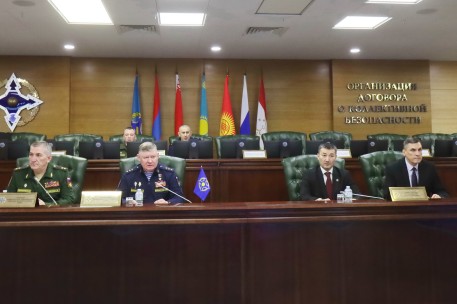
From 16 to 19 March, the Collective Security Treaty Organization is conducting a strategic command-and-staff training of the Joint Staff, the Secretariat, and relevant ministries and agencies of the CSTO member states under the leadership of Chief of the Joint Staff Colonel General Andrey Serdyukov.
The event is aimed at working out issues related to preparing proposals for CSTO bodies on providing military and military-technical assistance to the Organization’s member states.
In his opening remarks, Chief of the Joint Staff Colonel General Andrey Serdyukov noted, in particular, that “the strategic command-and-staff training is being conducted in conditions where the military-political situation is characterized by increased confrontation at global and regional levels and by the approach of ‘zones of instability’ directly to the area of responsibility of the CSTO member states.”
According to the scenario, the strategic command-and-staff training is conducted in four stages, during which it is planned to sequentially practice issues related to preparing collective decisions on the formation and deployment of all components of the CSTO collective security system’s forces and assets, as well as a set of measures for responding to crisis situations in the Eastern European and Central Asian regions of collective security.
Upon the established signal, notification and assembly of the personnel of the Joint Staff and the Organization’s Secretariat were carried out. Measures were implemented to deploy the functional groups of the CSTO Crisis Response Center and the command posts of national authorities authorized to interact with it.
This year, representatives of the CSTO Permanent Council, the Secretariat of the CSTO Parliamentary Assembly, the Anti-Terrorism Center of the CIS member states, and the Coordination Service of the Council of Commanders of the Border Troops are also taking part in the training.
During the first stage, issues related to preparing proposals and drafting decisions of the Organization’s bodies on the formation and operational deployment of the CSTO Collective Rapid Reaction Forces and on providing military-technical assistance to a member state of the Organization are being practiced.
During the second stage, tasks are envisaged for preparing proposals and drafting collective decisions on the formation and deployment of the Collective Rapid Deployment Forces of the Central Asian region and on providing military-technical assistance.
During the third stage, it is planned to practice tasks related to preparing a peacekeeping operation on the territory of a hypothetical CSTO member state.
The fourth stage involves practicing issues related to the formation, deployment, and employment of the CSTO joint formation for radiation, chemical, and biological protection and medical support.
Each stage concludes with a review of the drafted decisions of the Organization’s bodies concerning the formation, deployment, and employment of the components of the CSTO troops (Collective Forces), the comprehensive support of force groupings, and the provision of military-technical assistance to member states.
Upon completion of the strategic command-and-staff training, all drafted decisions of CSTO bodies will be communicated to the member states as initial data for the development of planning documents for joint and special exercises conducted within the Organization’s framework in September–October of the current year on the territories of the Russian Federation, the Republic of Kazakhstan, and the Republic of Belarus.