At the Losvido training range in the Republic of Belarus, peacekeeping units repelled a simulated enemy attack on a humanitarian convoy during the command-and-staff exercise with the CSTO Peacekeeping Forces “Indestructible Brotherhood-2026”.
These days, the 23rd International Combat Sambo Tournament for the Cup of the Secretary General of the Collective Security Treaty Organization, featuring law enforcement personnel from CSTO member states, is being held at the Ognikovo Park Hotel (19 Ognikovo, Istra District, Moscow Region).
At the Losvido training range in the Republic of Belarus, peacekeeping units practiced tactical procedures at a stationary checkpoint as part of the process of coordinating units and practicing joint actions during the command-and-staff exercise with the CSTO Peacekeeping Forces “Indestructible Brotherhood-2026”.
Today, at the Starodorozhsky training range in the Republic of Belarus, servicemen of the CSTO joint NBC protection and medical support formation began practical operations as part of the “Barrier-2026” special exercise.
The CSTO Military Committee discussed issues of the development of military cooperation of the Collective Security Treaty Organization member states via video-conferencing
 03.07.2020
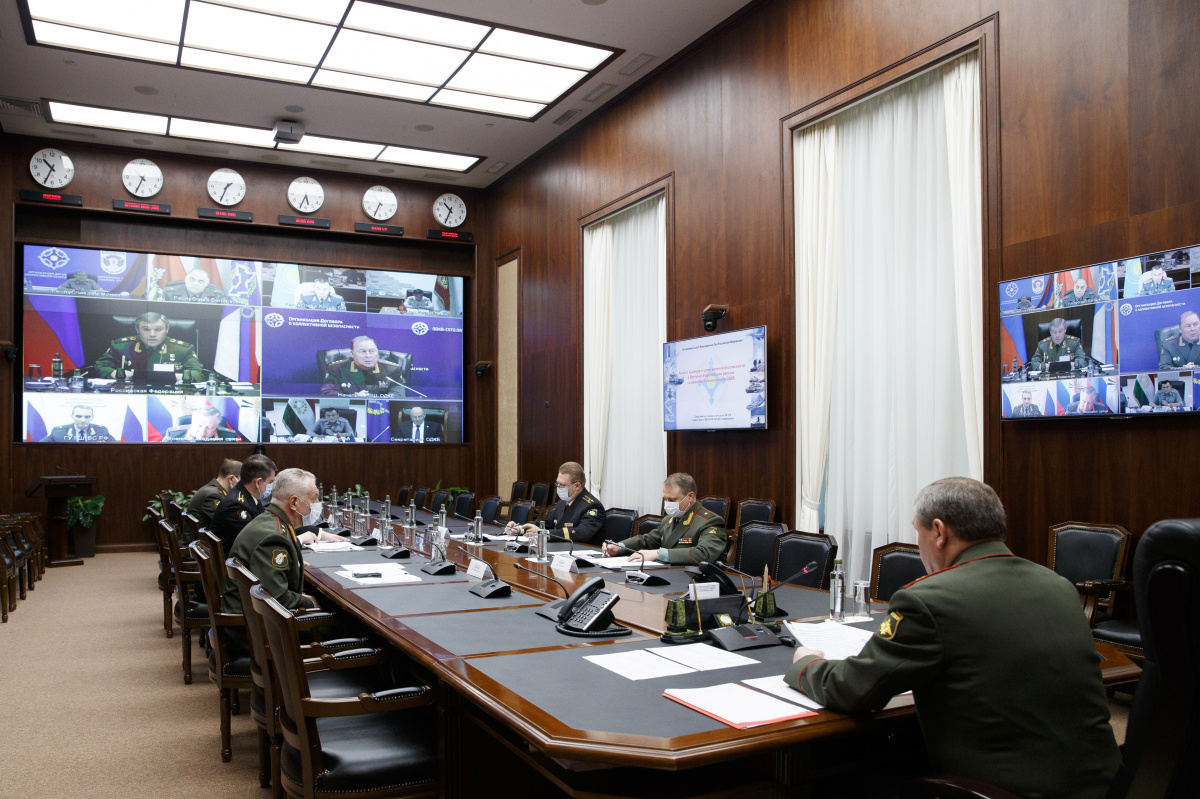
On July 3, 2020, for the first time via video-conferencing, the 16th Meeting of the Military Committee on the development of military cooperation of the of the Collective Security Treaty Organization member states was held.
The meeting was chaired by the Chairman of the Military Committee, the Chief of the General Staff of the Armed Forces of the Russian Federation and the First Deputy Minister of Defense of the Russian Federation, Army General Valery Gerasimov, attended by the chiefs of the General Staffs of the armed forces of the Republic of Armenia, the Republic of Belarus, the Republic of Kazakhstan, the Republic of Tajikistan, the Deputy Chief of the General Staff of the Armed Forces of the Kyrgyz Republic and Head of the Joint Staff of the CSTO. The event was also attended by the Deputy Secretary General of the Organization Piotr Tsikhanouski.
At the beginning of the meeting, Army General Valery Gerasimov congratulated the members of the Military Committee on the 75th anniversary of the Great Victory in the Great Patriotic War, and thanked for the quality training and participation of the military personnel of the armies of the CSTO member states in the parade on Red Square.
A discussion regarding the challenges and threats to military security in the CSTO Caucasus, East European and Central Asian regions of collective security was held. Presentations were made by representatives of the General Staffs of the Armed Forces of the Republic of Armenia, the Russian Federation and the Republic of Kazakhstan.
Colonel General Anatoly Sidorov, the Head of the CSTO Joint Staff, informed the members of the Military Committee about joint operational and combat training activities in 2020, about the draft Development Plan for the military cooperation of the CSTO member states for 2021–2025, and about proposals for improving international flights of aviation by the armed forces of the states - CSTO members and on comprehensive research work related to the CSTO Collective Aviation Forces.
The meeting participated in debriefing regarding the activities of the Military Academy of Communications named after Marshal of the Soviet Union S. M. Budyonny.
In conclusion of the meeting, the Chairman of the Military Committee, Army General Valery Gerasimov noted that the issues considered at the meeting of the Military Committee would serve to strengthen the collective security and stability of the Organization's member states.