On October 7, 2026, the Fourth Counter-Terrorism Forum opened in Minsk (Republic of Belarus), bringing together the CIS Conference on Countering Terrorism and Extremism, the SCO Regional Anti-Terrorist Structure international scientific and practical conference, and joint counter-terrorism exercises.
October 7 marks the 24th anniversary of the signing of the Charter of the Collective Security Treaty Organization, which formalized the establishment of the CSTO as an international regional organization. The goals set out in the document, including strengthening peace and stability and collectively protecting the independence, territorial integrity and sovereignty of the member states, remain the foundation for developing mutually beneficial, truly allied cooperation. On this basis, the Russian Federation is chairing the CSTO in 2026 under the motto “Collective security in a multipolar world: a common goal, shared responsibility.”
From October 18 to 23 this year, a special exercise codenamed “Cobalt-2026” will be held in the Republic of Tajikistan.
Today, the active phase of the command-and-staff exercise with the Collective Operational Reaction Forces (CORF) of the CSTO “Interaction-2026” and the special exercises “Search-2026” and “Echelon-2026” concluded in the Russian Federation.
Regular meeting of the CSTO Council of Foreign Ministers held in Kazan
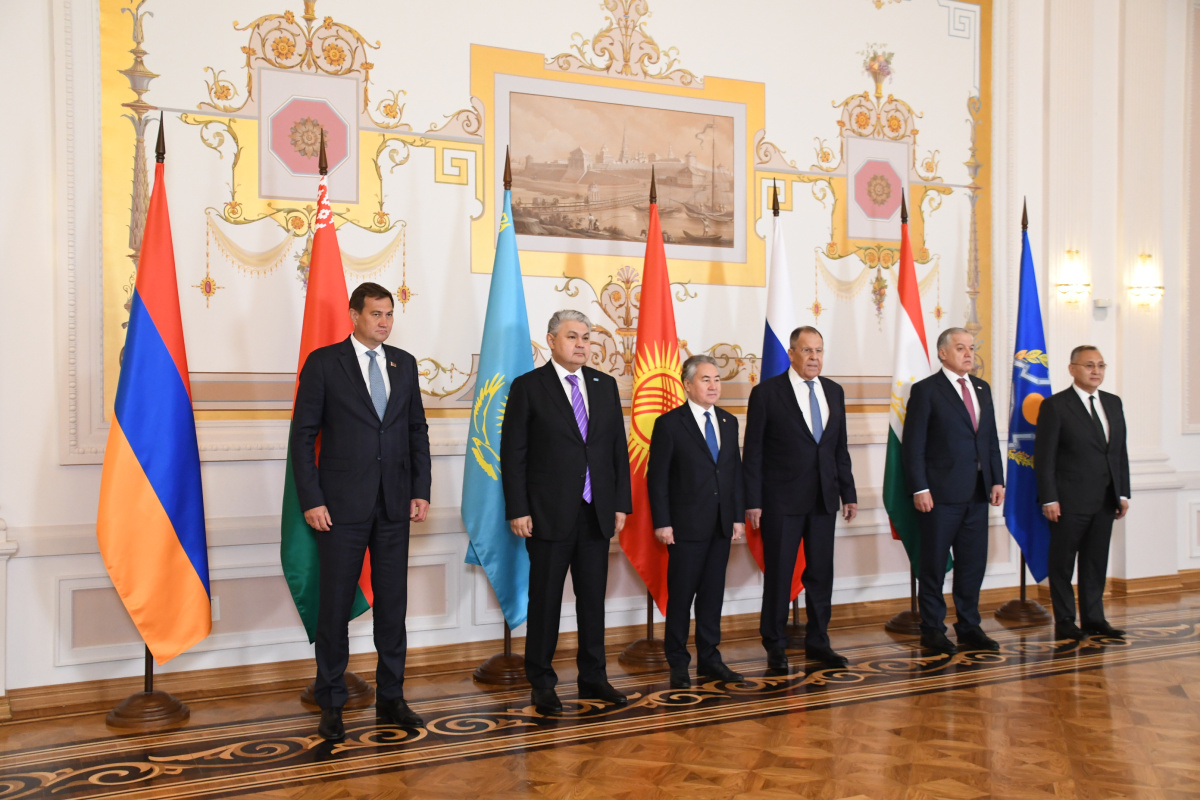 10.06.2026
On June 10, 2026, a regular meeting of the CSTO Council of Foreign Ministers was held in Kazan (Russian Federation) under the chairmanship of the Russian side, with the participation of CSTO Secretary General Talatbek Masadykov. CIS Deputy Secretary General Denis Trefilov and SCO Deputy Secretary General Oleg Kopylov were also invited to attend the meeting.
The event began with a flower-laying ceremony at the Eternal Flame in Victory Park.
The participants held a detailed discussion of the international and regional situation and its impact on the security of the CSTO member states.
During the discussion, Chairman of the CSTO Council of Foreign Ministers and Minister of Foreign Affairs of the Russian Federation Sergey Lavrov noted:
“Today, it is precisely in Eurasia that processes are unfolding which have a direct impact on the formation of a more just multipolar world order. First and foremost, this concerns the emergence and strengthening of new global centers and their integration associations located in this region. It is evident that a polycentric architecture must be based on the principles of the UN Charter in their entirety and interconnection, take into account the cultural and civilizational diversity of the modern world, and respect the right of peoples to determine their own paths and models of development. It is on the basis of these values that our allied relations within the CSTO are built.
Disregard for fundamental norms of international law and attempts to solve one’s own problems and strengthen one’s security at the expense of others through the use of force do not lead to peace but rather to the destabilization of international relations, aggravating existing conflicts and creating new ones.”
CSTO Secretary General Talatbek Masadykov stated in particular:
“Dialogue on strategic stability has virtually ceased. Efforts to develop the latest systems of strategic offensive and defensive weapons have intensified, while statements are being made about the possible resumption of nuclear testing. Intentions have been voiced to deploy intermediate- and shorter-range missiles in various regions of the world and to place strike weapons in outer space. At the same time, ideas aimed at achieving decisive superiority through the introduction of artificial intelligence into all areas of military activity are being revived.
Thus, we are witnessing the resumption of an arms race, which in the coming years will have a direct adverse impact on the stability of the Eurasian space. We are closely monitoring and analyzing these trends.”
Following the meeting, the foreign ministers of the CSTO member states adopted a statement marking the 85th anniversary of the outbreak of the Great Patriotic War of 1941–1945, as well as statements on preventing an arms race in outer space, countering the use of information and communication technologies for subversive and terrorist purposes, strengthening the role of international law, and reaffirming commitment to the principles of the UN Charter.
In addition, a number of documents were approved, including the draft Decision of the CSTO Collective Security Council “On the Anti-Drug Strategy of the Member States of the Collective Security Treaty Organization until 2030.”