Servicemen of the Combined Arms Army of the Central Military District (CMD) have arrived in the Republic of Belarus to take part in the command-and-staff exercise with the CSTO Peacekeeping Forces “Indestructible Brotherhood-2026” and the special exercise with the CSTO joint NBC protection and medical support formation “Barrier-2026”.
On October 7, 2026, the Fourth Counter-Terrorism Forum opened in Minsk (Republic of Belarus), bringing together the CIS Conference on Countering Terrorism and Extremism, the SCO Regional Anti-Terrorist Structure international scientific and practical conference, and joint counter-terrorism exercises.
October 7 marks the 24th anniversary of the signing of the Charter of the Collective Security Treaty Organization, which formalized the establishment of the CSTO as an international regional organization. The goals set out in the document, including strengthening peace and stability and collectively protecting the independence, territorial integrity and sovereignty of the member states, remain the foundation for developing mutually beneficial, truly allied cooperation. On this basis, the Russian Federation is chairing the CSTO in 2026 under the motto “Collective security in a multipolar world: a common goal, shared responsibility.”
The CSTO Secretary General spoke at Third CIS Conference on Countering Terrorism and Extremism
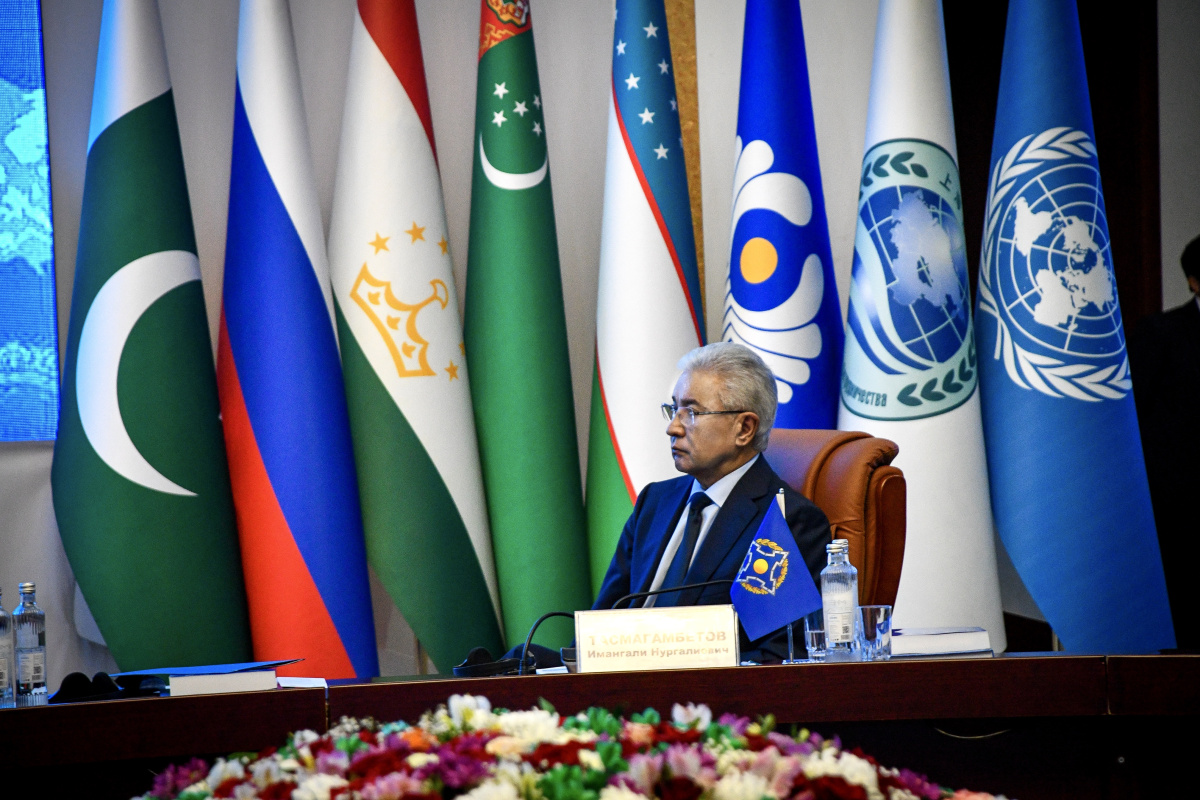 23.10.2025
On October 23, 2025, Secretary General of the Collective Security Treaty Organization (CSTO) Imangali Tasmagambetov took part in the Third Conference of the Commonwealth of Independent States (CIS) on Countering Terrorism and Extremism.
In his speech, Imangali Tasmagambetov emphasized the qualitative transformation of the terrorist threat in the modern world and called for strengthening coordinated measures within the CSTO, the CIS, and the SCO formats.
"In the context of the breakdown of previous agreements and the unprecedented growth of conflict potential in the world, terrorism is no longer a tool of marginal groups, but is increasingly establishing itself as an industry, often based on the political and economic interests of specific countries and blocs, which do not act spontaneously, but use advanced methods of analysis, planning, and implementation of their plans with the aim of weakening their competitors. Terrorism is becoming an increasingly complex threat, integrated into a system of hybrid warfare that includes the creation of military-political, economic, informational, technological, biological, and other types of confrontation," the CSTO Secretary General said.
In this regard, he stressed the need for urgent and coordinated measures by the CSTO, the CIS, and the SCO countries. The Secretary General elaborated on the practical measures already being implemented within the CSTO framework, noting that "the Organization is actively developing mechanisms for cooperation not only between the competent services of the Organization's member states. We have accumulated considerable practical experience – methodologies and practices of cooperation at the level of foreign policy, law enforcement, and military agencies of member states, developed over many years and aimed at depriving international terrorist organizations of their “breeding ground.” These are implemented in the course of ongoing operations conducted by the competent authorities of our states, such as “Channel,” “Illegal,” “PROXY,” and “Mercenary.” Their goal is to systematically combat drug trafficking, to suppress illegal migration and prevent the use of information and communication technologies for the dissemination of terrorist and extremist ideologies, as well as to block channels for the recruitment and entry/exit of citizens of our states for participation in terrorist activities and to neutralize the resource base of terrorist organizations”.
The conference was organized by the State Committee for National Security of the Republic of Tajikistan and the Anti-Terrorism Center of the CIS Member States. The event was attended by more than 150 delegates from 12 countries, as well as representatives of 10 international organizations, including the CIS Deputy Secretary General Nurlan Seitimov, the Head of the CIS Anti-Terrorism Center Yevgeny Sysoev, and the SCO Deputy Secretary General Piao Yangfan.
During the conference, participants discussed a wide range of issues, including national experiences in countering terrorism, international cooperation, and challenges related to the use of modern technologies, such as artificial intelligence, for terrorist purposes.