October 7 marks the 24th anniversary of the signing of the Charter of the Collective Security Treaty Organization, which formalized the establishment of the CSTO as an international regional organization. The goals set out in the document, including strengthening peace and stability and collectively protecting the independence, territorial integrity and sovereignty of the member states, remain the foundation for developing mutually beneficial, truly allied cooperation. On this basis, the Russian Federation is chairing the CSTO in 2026 under the motto “Collective security in a multipolar world: a common goal, shared responsibility.”
From October 18 to 23 this year, a special exercise codenamed “Cobalt-2026” will be held in the Republic of Tajikistan.
Today, the active phase of the command-and-staff exercise with the Collective Operational Reaction Forces (CORF) of the CSTO “Interaction-2026” and the special exercises “Search-2026” and “Echelon-2026” concluded in the Russian Federation.
In the Russian Federation, at the Chebarkulsky training range, particular attention is being paid to organizing the evacuation and repair of damaged equipment under the threat of enemy UAV attacks during the special exercise with the logistics forces and assets of the CSTO Troops (Collective Forces) “Echelon-2026”.
The CSTO Secretary General Imangali Tasmagambetov spoke during a joint meeting of the Council and the 18th plenary session of the CSTO Parliamentary Assembly
 08.12.2025
The CSTO Secretary General Imangali Tasmagambetov spoke during a joint meeting of the Council and the 18th plenary session of the CSTO Parliamentary Assembly
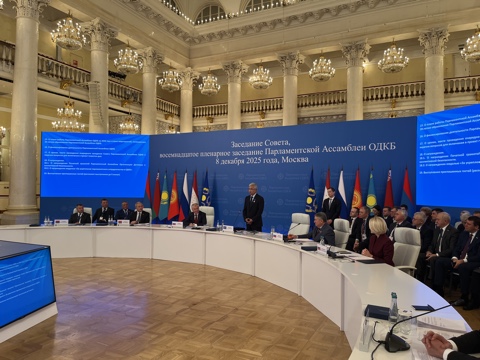
On December 8, a joint meeting of the Council and the 18th plenary session of the CSTO Parliamentary Assembly were held in Moscow. During the event, the CSTO Secretary General Imangali Tasmagambetov presented information on “The results of the regular November (2025) session of the CSTO Collective Security Council and the current activities of the Organization.”
Dear Chairman,
Dear members of the Council and participants of the plenary session of the CSTO Parliamentary Assembly,
I am grateful for the invitation to speak at today's meeting of the Council of the Parliamentary Assembly of the Collective Security Treaty Organization. I would like to take this opportunity to report on the results of the meeting of the CSTO Collective Security Council (CSC) held in Bishkek on November 27, which reviewed the Organization's work over the past year and outlined the main areas of activity for the period of Russia's chairmanship in 2026.
During the meetings of the CSTO's highest statutory bodies, a comprehensive assessment of the current international political situation in the world was given, which was reflected in the CSTO Declaration. The document specifically notes that in the year of the 80th anniversary of Victory in the Great Patriotic War, our states once again advocate for comprehensive dialogue aimed at strengthening peace and security in accordance with the principles and objectives of the UN Charter. It states that collective efforts at the regional and global levels to prevent and resolve crises and conflicts are becoming an important factor in maintaining security.
The Kyrgyz Republic's chairmanship in 2025, held under the motto “80 Years of the Great Victory,” was highly praised. The Plan of events adopted a year ago by the heads of our states to celebrate the anniversary was successfully implemented. Comprehensive celebrations were held in the CSTO member states to preserve the historical memory of the feat of our peoples in 1941-1945 and to educate new generations.
As stated in the joint statement adopted on September 3 this year by the CSTO, the CIS, and the SCO in connection with the 80th anniversary of the end of World War II and the formation of the United Nations: “Preserving and objectively reflecting the historical truth about World War II is a necessary condition for preventing the recurrence of such tragedies and strengthening peace, security, and cooperation.”
Overall, during the session of the CSTO Collective Security Council of the in Bishkek, 16 documents were signed aimed at further improving and strengthening the CSTO. The most important of these are:
- Collective Security Strategy. The current document was valid until the end of 2025. However, given the continued relevance of the Strategy, it was decided to extend it, bringing it into line with current realities. The Organization intends to continue building up the combat potential of the CSTO Forces (Collective Forces), including by equipping them with modern reconnaissance systems, electronic warfare and unmanned (robotic) systems, and automated troop control systems. Training programs for military personnel of the armed forces of the CSTO member states will be improved, taking into account the latest developments in military science, technology, and best practices.
- The Anti-Drug Strategy for 2026-2030 defines coordinated approaches for all relevant agencies in the field of countering the drug threat and the main areas of cooperation between the authorized bodies of the CSTO member states.
- Military Cooperation Development Plan for 2026–2030. Its implementation will be aimed primarily at improving the management system, developing and optimizing the composition of the CSTO Collective Forces, equipping them with modern and promising weapons and military equipment, including UAVs, air defense, reconnaissance, and electronic warfare systems, as well as training and preparing CSTO Collective Forces personnel.
- “On the Organization of Command of the CSTO Forces (Collective Forces)”. This document amends a similar decision by the CSC from 2015, which will enable qualitative improvements and systematization of the command of the Organization's Collective Forces.
The heads of state decided to appoint Taalatbek Masadikov, representative of Kyrgyzstan, as the CSTO Secretary General from January 1, 2026. I would like to wish him success in further improving the CSTO.
Dear parliamentarians,
The Bishkek session of the CSC has convincingly demonstrated the need for further improvement of the collective security system.
Taking into account the decisions made, as well as the guidelines of the Council of Foreign Ministers, the Council of Defense Ministers, and the Committee of Security Council Secretaries, the Secretariat intends to give priority attention in its work to further strengthening the military-political component of the CSTO – the development of the CSTO Collective Forces components, command and control systems, and comprehensive support, their preparation for performing their earmarked tasks, and improving the efficiency of decision-making and implementation regarding the use of forces and means of the CSTO collective security system.
Key tasks:
• Improving the regulatory framework for the rapid deployment of military components (Collective Forces), including the organization of unimpeded (non-stop) transit of contingents and flights;
• organizing and conducting joint operational and combat trainings;
• strengthening military-technical cooperation among the CSTO member states, implementing measures under the Plan for Equipping the Collective Rapid Reaction Forces;
• further development of the military training system and military-scientific potential of the CSTO member states;
• development of the CSTO's peacekeeping potential, improvement of the activities of the CSTO Secretary General's Special Representative on Peacekeeping Issues.
The main task for the CSTO will remain the implementation of the Special Interstate Policy for strengthening sections of the Tajik-Afghan Border, which was approved at the CSTO meeting in Astana in 2024. It is designed to ensure the security of the entire Central Asian region. At present, the CSTO is assisting in the implementation of the first stage of the policy – clarifying and agreeing on lists of weapons, military equipment, and technical means of border protection to be supplied to the Border Troops of Tajikistan in the member states of the Organization.
In the area of countering challenges and threats, we will consistently build capacity and experience aimed at improving the effectiveness of the fight against terrorism and extremism, countering drug trafficking, combating illegal migration, and fighting crimes in the field of information technology. We will continue to carry out practical measures in the form of special operations under the code names “Mercenary,” “Channel,” “Illegal,” and “PROXY.” We will coordinate activities in the field of preventing biological threats with the aim of creating a reliable system for ensuring the biological security of the CSTO.
We intend to continue the practice of coordinating joint political statements to convey to the international community the CSTO's common approaches to pressing international issues. The focus will be on priority issues such as regional security, arms control, international information security, and the agenda of the UN General Assembly. We intend to strengthen cooperation with other international organizations, primarily with the United Nations. We will consistently develop cooperation in the areas of peacekeeping, combating terrorism and drug trafficking, as well as countering threats in the field of international information security. Such work invariably receives a positive international response.
We associate the prospects for stability in Eurasia with the strengthening of the trilateral format – the CSTO, the CIS, and the SCO – aimed at forming a new continent-wide architecture for cooperation in the areas of security, economics, and humanitarian affairs. An important step in this direction last year was the signing on September 3 by the secretaries general of the three organizations of a road map for the development of cooperation between the CSTO, the SCO, and the CIS for 2026-2028. We believe that its implementation will lay the foundation for more active joint efforts in the field of strengthening security.
Dear parliamentarians!
To ensure coordinated work in the areas I have outlined, it is becoming increasingly important to improve the regulatory framework governing the formation and functioning of the CSTO forces (Collective Forces) and their logistical support. The meetings of the CSTO Parliamentary Assembly Council are dynamic and productive.
I would like to note the high intensity and effectiveness of parliamentary work on coordinating a harmonized legislative framework for CSTO member states in the field of defense and security.
We note with satisfaction that, for the first time, parliamentarians participated as observers in the Strategic Command and Staff Training in March 2025.
We also intend to continue supporting the role of the Coordination Meeting of the Chairpersons of the Defense and Security Committees (Commissions) of the Parliaments of the CSTO member states under the Council of the CSTO Parliamentary Assembly in practical work on issues related to the organization of management and coordination of the Collective Forces commands. The high-quality conduct of joint operational and combat training activities to maintain the readiness of the Collective Forces to respond to crisis situations remains a priority task for the Organization.
The extraordinary meeting of the standing committees of the CSTO PA held on November 6 this year in St. Petersburg deserves a very positive assessment. We welcome the draft of the Organization's new model legislation program for 2026-2030, which was adopted following the meeting. The coordination and subsequent implementation of the new model legislation program until 2030 is an important step towards further convergence of the legal systems of the CSTO countries and strengthening collective security in the region.
Dear Chairman,
Dear members of the Council and participants of the plenary session of the CSTO Parliamentary Assembly,
In conclusion, I would like to emphasize that my three years of experience working in the Organization demonstrate that the political and diplomatic format of interaction within the CSTO Parliamentary Assembly has proven its viability and effectiveness.
I would like to express my sincere gratitude for our joint efforts and express my confidence that close coordination between the Secretariat and the Parliamentary Assembly will further strengthen the Organization's potential and contribute to the creation of an effective security space in Eurasia.
Thank you for your attention.