Servicemen of the Combined Arms Army of the Central Military District (CMD) have arrived in the Republic of Belarus to take part in the command-and-staff exercise with the CSTO Peacekeeping Forces “Indestructible Brotherhood-2026” and the special exercise with the CSTO joint NBC protection and medical support formation “Barrier-2026”.
On October 7, 2026, the Fourth Counter-Terrorism Forum opened in Minsk (Republic of Belarus), bringing together the CIS Conference on Countering Terrorism and Extremism, the SCO Regional Anti-Terrorist Structure international scientific and practical conference, and joint counter-terrorism exercises.
October 7 marks the 24th anniversary of the signing of the Charter of the Collective Security Treaty Organization, which formalized the establishment of the CSTO as an international regional organization. The goals set out in the document, including strengthening peace and stability and collectively protecting the independence, territorial integrity and sovereignty of the member states, remain the foundation for developing mutually beneficial, truly allied cooperation. On this basis, the Russian Federation is chairing the CSTO in 2026 under the motto “Collective security in a multipolar world: a common goal, shared responsibility.”
Briefing by the Chief of the CSTO Joint Staff on the results of joint training of command and control bodies and forces of the collective security system in 2025 and tasks for 2026
 12.02.2026
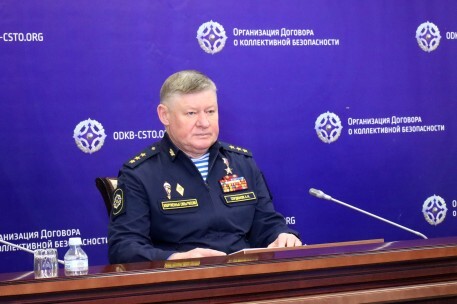
On 12 February, a briefing was held at the CSTO Crisis Response Center by Chief of the CSTO Joint Staff Colonel General Andrey Nikolaevich Serdyukov on the topic “Results of the joint training of command and control bodies and forces of the CSTO collective security system in 2025 and tasks for 2026.”
Via videoconference, the event was attended by representatives of the press services of defense agencies and accredited mass media of the CSTO member states.
During the event, the Chief of the CSTO Joint Staff spoke about the main trends in the military-political situation in the Organization’s area of responsibility, the results of joint training in 2025, priorities for activities in 2026 taking into account the chairmanship of the Russian Federation in the Organization, as well as the set of joint exercises planned with the CSTO troops (collective forces).
Below is information based on the briefing materials.
Summing up the results of joint training, it should first of all be noted that 2025 was characterized by a growing level of geopolitical tension and a deterioration of the situation in the regions of collective security due to the direct proximity of “zones of instability” to the borders of the CSTO member states.
In this regard, the work of the Joint Staff in 2025 was organized taking into account the evolving situation and in accordance with the tasks set by the heads of state and ministers of defense, with an emphasis on implementing the priorities of the Kyrgyz Republic’s chairmanship.
At the same time, our main task was to maintain a high level of readiness of the Collective Forces to carry out their designated missions in the interests of ensuring peace, stability, and security in the Organization’s area of responsibility, as well as creating conditions for the further sustainable development of our states.
The most important result of the work of the Joint Staff, the Secretariat, and the relevant ministries and agencies of the CSTO was the approval by the heads of state of the Plan for the Development of Military Cooperation of the CSTO Member States for 2026–2030. This document defines a set of measures for coalition military development for the next five-year period, including the formation of a prospective model of the Organization’s military component in the long term.
In 2025, the practice of conducting joint training activities against a unified background of the training military-political and military-strategic environment was continued. This environment was developed jointly with defense agencies, taking into account the real situation in the CSTO area of responsibility, as well as forecasts of possible challenges and threats to collective security.
The joint training plan for 2025 was fully implemented. A total of 61 activities were conducted, including consultations, staff talks, separate and joint staff training events, working meetings on the development and coordination of exercise concepts, reconnaissance of exercise areas, as well as joint and special exercises.
One of the key joint training activities was the strategic command-and-staff training conducted in March involving the Joint Staff, the Secretariat, and operational groups of the relevant ministries and agencies of our states, within the framework of which a comprehensive set of crisis response measures was consistently practiced.
During the exercises conducted on the territories of the Republic of Belarus, the Kyrgyz Republic, and the Republic of Tajikistan, issues related to the deployment of national contingents to areas of training and combat missions, the formation and coordination of newly created command structures and force groupings, as well as their employment in carrying out assigned tasks taking into account the experience of modern armed conflicts, were practiced. Particular attention was paid to the deployment of command and control systems, the establishment of command posts, and ensuring their survivability, including protection against strikes by enemy unmanned aerial vehicles.
At the same time, during the “Interaction” exercise conducted on the territory of Belarus, tasks related to the employment of the Collective Rapid Reaction Forces to ensure the deployment of the Russian-Belarusian regional grouping of troops were practiced as part of the joint strategic exercise “West-2025.”
During the “Rubezh” exercise on the territory of the Kyrgyz Republic, the joint actions of the Collective Rapid Deployment Forces of the Central Asian region to block and eliminate illegal armed formations in mountainous terrain and in the waters of Lake Issyk-Kul were practically practiced.
At the final stage of the joint training cycle, during the “Unbreakable Brotherhood” exercise on the territory of Tajikistan, in addition to issues related to the preparation and conduct of a peacekeeping operation, joint actions with units of the competent authorities of the CIS member states were practiced for the first time.
For this purpose, the active phases of the anti-terrorism exercise “Commonwealth Anti-Terror-2025” were combined with the CSTO peacekeeping exercise.
In addition, for the first time within the framework of a peacekeeping exercise, a special exercise entitled “Barrier” was conducted with a joint formation for radiation, chemical, and biological protection and medical support, during which tasks related to ensuring biosecurity in the interests of conducting a peacekeeping operation were practically practiced.
Thus, the joint exercises made it possible to practice the necessary range of training tasks related to the implementation of crisis response mechanisms and the employment of the Collective Forces to resolve them. Training and research objectives were achieved. The personnel of the participating units and subunits demonstrated good field training and coordinated actions. Participants gained practical experience in preparing and conducting joint operations as part of a multinational contingent.
I would like to express sincere gratitude to the leadership of the ministries of defense and agencies for the high level of organization and the quality conduct of all activities, as well as for the assistance and support provided.
Based on the results of the exercises conducted, and in order to incorporate the combat experience of the Armed Forces of the Russian Federation into the training of command and control bodies and formations of the Collective Forces, the Joint Staff has completed the development of methodological guidelines, which will be sent to defense agencies in the near future for use in the preparation and conduct of joint exercises already this year.
It should also be emphasized that the joint exercises received wide coverage in leading mass media outlets.
The Joint Staff expresses its appreciation to the teams of information units of defense agencies and editorial offices for their high professionalism and active information support of activities conducted within the framework of the Organization.
It is also important to note that, in commemoration of the 80th anniversary of the Great Victory, a series of television reports was produced on the preparation and participation of national parade contingents of the defense agencies of CSTO member states in the military parade on Red Square. This testifies to the preservation of sacred historical memory, the feat of our peoples, and symbolizes the unity of our states.
Overall, it can be stated that over the course of the year the Organization carried out a significant amount of work both on developing its military component and on maintaining the readiness of forces and assets to ensure collective security.
The joint training plan for 2026 has been approved. The composition of national contingents of the Collective Forces and the planning documents for their operational deployment have been уточнены.
During the year, a large volume of no less important and complex tasks is to be accomplished. At the same time, the main efforts will be focused on implementing the priority areas of activity declared by the Russian Federation for the period of its chairmanship of the Organization, conducted under the motto announced by the President of Russia, “Collective security in a multipolar world: a single goal – shared responsibility.”
At the same time, important tasks for improving the Organization’s military component, as noted by the President of Russia, include:
increasing the combat potential of national contingents and equipping them with modern weapons systems;
optimizing procedures for the operational deployment of coalition troop groupings;
developing the aviation component and air defense assets within the CSTO framework;
improving command and control of Collective Forces groupings.
Within the framework of implementing these priority tasks, appropriate joint work with CSTO member states has been planned and organized.
Taking into account existing and forecasted challenges and threats to collective security, one of the priority tasks is, first of all, the high-quality organization and effective conduct of joint training activities.
In accordance with the approved plan for 2026, 60 activities are envisaged, including eight command-and-staff (joint) and special exercises:
in March – a strategic command-and-staff training involving the Joint Staff, the Secretariat, and operational groups of relevant ministries and agencies of our states;
in September, on the territory of the Republic of Kazakhstan – the joint exercise with units of the Collective Rapid Deployment Forces of the Central Asian region “Rubezh-2026”;
in September–October, in the Russian Federation – a command-and-staff exercise with the Collective Rapid Reaction Forces “Interaction-2026,” special exercises with intelligence forces and assets “Search-2026,” and with logistics forces and assets “Echelon-2026”;
in October:
on the territory of the Republic of Tajikistan:
the special exercise “Cobalt-2026”;
the special exercise “Rock-2026”;
on the territory of the Republic of Belarus – a command-and-staff exercise with the Peacekeeping Forces “Unbreakable Brotherhood-2026” and a special exercise with a joint formation for radiation, chemical, and biological protection and medical support “Barrier-2026.”
At the same time, during the strategic command-and-staff training, issues related to the employment of all components of the Collective Forces involved in the joint exercises will be practiced.
Observers are planned to participate in the training, including representatives of the CIS Anti-Terrorism Center, the Coordinating Service of the Council of Commanders of the CIS Border Troops, and the Secretariat of the CSTO Parliamentary Assembly. Documents developed during the strategic training will form the basis for the concepts of the upcoming joint exercises.
The main exercises in terms of tasks, scale, and composition of participants – “Interaction,” “Search,” and “Echelon” – will be conducted in the Russian Federation at training ranges of the Central Military District. Their concepts are planned to be closely aligned with the concept of the strategic command-and-staff exercise of the Armed Forces of the Russian Federation “Center-2026.”
It is expected that these exercises will be large-scale in nature, with demonstrations of the capabilities of modern and advanced Russian military equipment that has proven its effectiveness during the special military operation, including unmanned and robotic systems.
In order to improve command and control of the CRRF contingents during the preparation and conduct of these exercises, it is planned to practically practice the full range of measures for deploying the command and control system, taking into account the experience of the special military operation.
In addition, it is traditionally envisaged to engage the scientific potential of basic educational, methodological, and research organizations to study issues related to the organization of command and control and the employment of air defense, electronic warfare, and unmanned aviation forces and assets. During the special exercise “Barrier-2026,” it is planned to study issues related to the employment of the joint formation for radiation, chemical, and biological protection and medical support in collective response activities in the event of large-scale and rapid spread of dangerous infectious diseases, in close interaction with authorized bodies in the field of biosecurity of the Republic of Belarus.
I am confident that all joint activities will be conducted at a high level in the interests of achieving the main goal – maintaining the readiness of the Collective Forces to adequately respond to crisis situations and carry out tasks to ensure collective security.
These are the main results of 2025 and the tasks that lie ahead in 2026. I am confident that through organized joint efforts we will be able to successfully accomplish them and achieve all the objectives set by the heads of state.