At the Losvido training range in the Republic of Belarus, peacekeeping units repelled a simulated enemy attack on a humanitarian convoy during the command-and-staff exercise with the CSTO Peacekeeping Forces “Indestructible Brotherhood-2026”.
These days, the 23rd International Combat Sambo Tournament for the Cup of the Secretary General of the Collective Security Treaty Organization, featuring law enforcement personnel from CSTO member states, is being held at the Ognikovo Park Hotel (19 Ognikovo, Istra District, Moscow Region).
At the Losvido training range in the Republic of Belarus, peacekeeping units practiced tactical procedures at a stationary checkpoint as part of the process of coordinating units and practicing joint actions during the command-and-staff exercise with the CSTO Peacekeeping Forces “Indestructible Brotherhood-2026”.
Today, at the Starodorozhsky training range in the Republic of Belarus, servicemen of the CSTO joint NBC protection and medical support formation began practical operations as part of the “Barrier-2026” special exercise.
The CSTO Secretary General Stanislav Zas spoke at the ninth meeting of secretaries of security councils of the member States of the Commonwealth of Independent States
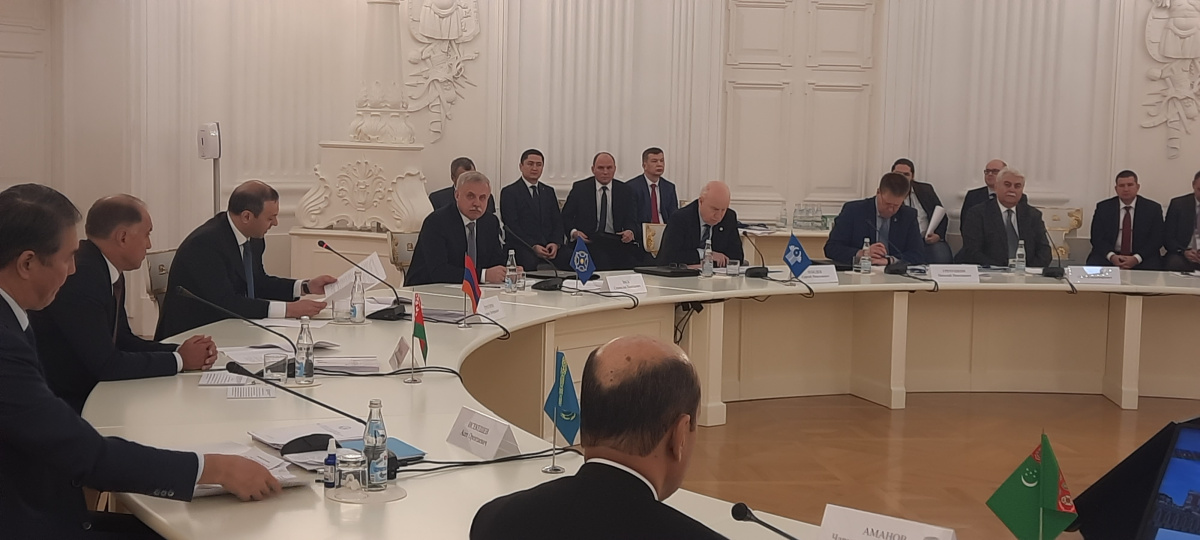 17.11.2021
WELCOME SPEECH
of the CSTO Secretary General
to the Ninth Meeting of Secretaries of Security Councils
of the member States of the Commonwealth of Independent States
(17 November 2021, Moscow)
Dear Nikolai Platonovich!
Dear meeting participants!
Dear friends!
Thank you for the invitation and I would like to emphasize that I am sincerely pleased to have the opportunity to meet with you once again and to participate in the meeting of Secretaries of Security Councils of the member States of the Commonwealth of Independent States.
Dear colleagues, globally, the modern world is experiencing an extremely acute phase of its development. The crisis in international relations is overlaid with unprecedented difficulties. There is a worldwide trend of growing crisis phenomena in almost all spheres of life and activity of modern civilization. Among other things, such traditional challenges and threats as terrorism and extremism, illegal drugs and weapons trafficking, and illegal migration are joined by new ones.
The pandemic of a new coronavirus infection COVID-19 remains a real challenge for the entire world community.
One of the tools of destructive influence on the socio-political and socio-economic situation in the states has become the use of modern information and communication technologies. The information pressure nowadays takes the form of information aggression.
The tendency to replace traditional moral and cultural values with stereotypes that are alien to human nature has become extremely disturbing. The powerful potential of the media and Internet resources is aimed at introducing them into the lives and livelihoods of people, especially young people.
As for regional security and, in particular, its provision in the CSTO area of responsibility, I have to state that for the CSTO member States the level of military danger is not decreasing.
This is indicated, among other things, by the expanding presence of military groups of the alliance countries, the development of their military infrastructure and the intensification of military activity in the immediate vicinity of our countries' western borders.
The trilateral agreements enshrined in the Statement of the leaders of the Republic of Armenia, the Republic of Azerbaijan and Russia of November 9, 2020 allowed to stop the bloodshed in Nagorno-Karabakh. However, despite the steps taken, there is still tension on the line of contact between the Armenian and Azerbaijani sides. Periodically there are clashes. Unfortunately, there are casualties, as it happened this week.
At the same time, the situation in the Central Asian region after the change of power in Afghanistan remains complicated, tense and unpredictable. In the near future there is a high probability of a complete collapse of the economy, social sphere and a humanitarian catastrophe in Afghanistan. In this case, we can expect an intensification of armed confrontation within Afghanistan, an increase in the activities of terrorist groups and the expansion of drug production. All of this will undoubtedly affect the security of all countries in the region.
Dear meeting participants, in light of what I have said, the issues such as threats emanating from the territory of Afghanistan, biosecurity, illegal migration and the use of information technology for criminal purposes are extremely important and topical for the Collective Security Treaty Organization as well.
Dear colleagues, I would like to take this opportunity to note that in the course of the session of the Collective Security Council held on September 16, this year, in Dushanbe, the heads of CSTO member States praised the activity of the Commonwealth of Independent States and noted the need to increase close cooperation between the CSTO and the CIS in the sphere of ensuring security and creating favorable conditions for the comprehensive development of our states and peoples. This thesis was reaffirmed in the Statement of the Ministers of Foreign Affairs of the CSTO member States on the occasion of the 30th anniversary of the Commonwealth of Independent States and the 20th anniversary of the Shanghai Cooperation Organization adopted on September 15, this year.
In this regard, I would like to assure you that the CSTO is ready to develop comprehensive cooperation with the Commonwealth of Independent States and its specialized structures in counteracting contemporary challenges and threats to the security of our states.
I thank you for your attention and wish you fruitful work.