Servicemen of the Combined Arms Army of the Central Military District (CMD) have arrived in the Republic of Belarus to take part in the command-and-staff exercise with the CSTO Peacekeeping Forces “Indestructible Brotherhood-2026” and the special exercise with the CSTO joint NBC protection and medical support formation “Barrier-2026”.
On October 7, 2026, the Fourth Counter-Terrorism Forum opened in Minsk (Republic of Belarus), bringing together the CIS Conference on Countering Terrorism and Extremism, the SCO Regional Anti-Terrorist Structure international scientific and practical conference, and joint counter-terrorism exercises.
October 7 marks the 24th anniversary of the signing of the Charter of the Collective Security Treaty Organization, which formalized the establishment of the CSTO as an international regional organization. The goals set out in the document, including strengthening peace and stability and collectively protecting the independence, territorial integrity and sovereignty of the member states, remain the foundation for developing mutually beneficial, truly allied cooperation. On this basis, the Russian Federation is chairing the CSTO in 2026 under the motto “Collective security in a multipolar world: a common goal, shared responsibility.”
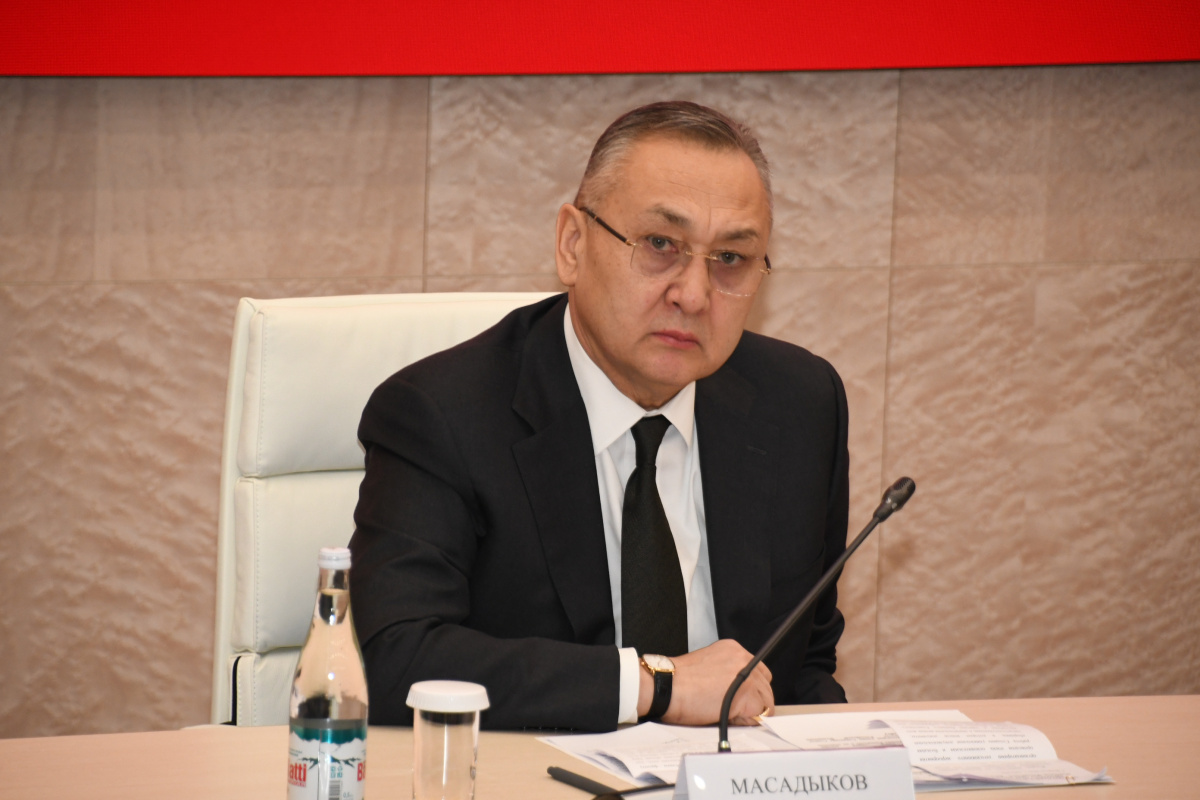
CSTO Secretary General Talatbek Masadykov addressed the presentation of the documentary collection series “Republics to the Front, 1941–1945”
 05.02.2026
On 5 February 2026, CSTO Secretary General Talatbek Masadykov addressed the presentation of the documentary collection series “Republics to the Front, 1941–1945,” organized by the Office of the Security Council of Russia, the Ministry of Science and Higher Education of the Russian Federation, the Russian Historical Society, and the Russian State University for the Humanities.
Text of the address:
Dear colleagues, dear friends,
First of all, I would like to express my gratitude to the organizers for the invitation to take part in the presentation of the documentary collection series “Republics to the Front, 1941–1945.” This work is evidence that our Great Victory was truly a shared one. It was forged on the battlefields and in the rear, in factory workshops and in the fields, by representatives of all peoples and all republics of a great country. Common efforts were directed toward a single goal: the defeat of Nazi Germany and its allies.
Preserving historical memory and the truth about the war is our moral duty. To remember the price of the Victory and to protect the truth from distortion means to honor the feat of our ancestors. Today, more than ever, it is important to rely on documents, facts, and archival evidence such as those collected in this publication. Attempts to rewrite history, to diminish the decisive contribution of our peoples to the defeat of Nazism, and to glorify the accomplices of criminals appear to be a deliberate policy aimed at undermining the values for which our ancestors fought and at weakening the legal and moral foundations of the world order established after 1945. As the heirs of the Victors, we cannot and will not allow this.
Issues of preserving the historical memory of the Great Patriotic War and the truth about our common Victory occupy a special place in the work of the Collective Security Treaty Organization. As part of preparations for the 80th anniversary of this event, considerable work was carried out.
An important element was the creation, at the initiative of then CSTO Secretary General Imangali Tasmagambetov, and in cooperation with the Research Institute of Military History of the Military Academy of the General Staff of the Armed Forces of the Russian Federation, of the encyclopedia “The Great Patriotic War of 1941–1945.” This scholarly work was highly appreciated by the leaders of our states at the session of the CSTO Collective Security Council in Bishkek.
In the year marking the anniversary of the Great Victory, our Organization held an international conference entitled “The Contribution of the Peoples of the CSTO Member States to Victory in the Great Patriotic War.” It brought together politicians, experts, historians, and descendants of the heroes, confirming that the shared memory of the feat is the foundation of our solidarity in addressing contemporary challenges.
This work culminated in the adoption by the CSTO Collective Security Council of a Statement on the 80th anniversary of Victory, which rejects any attempts to revise history, glorify Nazism, or desecrate the memory of the liberators, and emphasizes that the actions of the Nazis constituted genocide against the peoples of the Soviet Union. A unified position of leading Eurasian organizations on this issue was also set out in the Joint Statement by the Secretaries General of the CSTO, the CIS, and the SCO on the occasion of the 80th anniversary of the end of the Second World War and the establishment of the United Nations.
That is why today’s event is of particular importance to us. In the “Republics to the Front” collections, I see, among other things, an important and logical continuation of the systematic work carried out by our countries to preserve the memory of the Great Victory. These documents are direct, fact-based confirmation of what the leaders of our states have repeatedly emphasized.
I would also like to thank the team of compilers for their tremendous work in collecting and systematizing archival evidence.
Dear friends,
The “Republics to the Front” collections are an important contribution to ensuring that our children and grandchildren know the truth. So that they remember that soldiers from Almaty and Minsk, Bishkek and Dushanbe, Yerevan and Moscow, Tashkent and Baku, Ashgabat and Tbilisi stood shoulder to shoulder.
As long as we preserve memory and defend the truth, the sacrifices made on the altar of Victory were not in vain. The strength of our alliance lies in our shared history, our shared memory, and our shared responsibility for the future.
Thank you for your attention.