On October 30, 2026, the results of the “Channel-Caspian Lighthouse” subregional anti-drug operation were summed up as part of the implementation of the 2026 Plan of Key Activities of the Coordinating Council of Heads of Competent Drug Control Authorities of CSTO Member States (CCHCDCA).
From October 18 to 23 this year, in accordance with the 2026 Plan for the Joint Training of Command and Control Bodies and Formations of Forces and Assets of the Collective Security System of the Collective Security Treaty Organization, the “Cobalt-2026” special exercise was held at the Magob training range of the Special Purpose Units Training Center of the Ministry of Internal Affairs of the Republic of Tajikistan.
An international scientific and practical conference entitled “Greater Eurasia: Institutions, Development, Cooperation” was held at the Moscow State Institute of International Relations (MGIMO) of the Russian Ministry of Foreign Affairs, jointly organized with the Institute of China and Contemporary Asia of the Russian Academy of Sciences (ICCA RAS). CSTO Secretary General Talatbek Masadykov took part in the conference.
A working meeting between CSTO Secretary General Talatbek Masadykov and Kazem Jalali, Ambassador Extraordinary and Plenipotentiary of the Islamic Republic of Iran to the Russian Federation, was held at the Embassy of the Islamic Republic of Iran in the Russian Federation.
An international scientific and practical conference entitled “Transformation of the Global Security System and the Shaping of a Eurasian Security Framework” was held at Moscow State Linguistic University (MSLU).
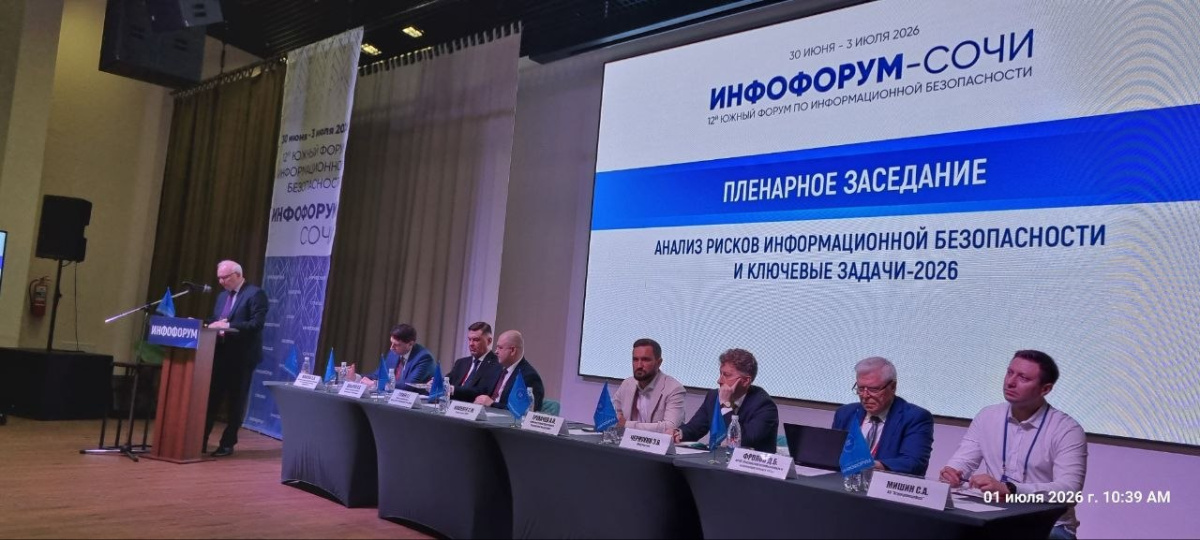
Delegation of the CSTO participates in the 12th Southern Information Security Forum “Infoforum Sochi 2026”
 01.07.2026
The 12th Southern Information Security Forum “Infoforum Sochi 2026” is taking place in Sochi, Russia, from June 30 to July 3. On July 1, the Forum's plenary session brought together representatives of federal and regional authorities, regulatory bodies, leading companies, and international organizations to discuss current challenges in the protection of critical infrastructure, the development of artificial intelligence, and international cooperation.
A delegation of the CSTO Secretariat is participating in the Forum, comprising Sergey Koshelev, Deputy Head of the Political Cooperation Department, and Alexander Kuznetsov, Adviser to the Department for Countering Challenges and Threats.
CSTO Secretary General Talatbek Masadykov sent a message of greetings to the Forum participants. In his address, he emphasized that “Cybersecurity is becoming an integral part of national defense. It is essential to establish joint response mechanisms, develop a common standard for the protection of critical information infrastructure, and introduce shared training programs.” The CSTO called on its member states to further consolidate their efforts in the digital domain to effectively counter contemporary threats.
At the plenary session, Alexey Ivanov, Chairman of the Working Group on Information Security under the CSTO Committee of Security Council Secretaries and Deputy Director of Russia's National Coordination Center for Computer Incidents, delivered a presentation. He focused on the growing number of cyberattacks, the need to protect supply chains, and significant changes to the regulatory framework, including new federal laws, Presidential decrees, and nearly ten orders issued by the Federal Security Service of Russia in 2026.
Alexey Ivanov also highlighted the ongoing development of the State System for Detecting, Preventing and Eliminating the Consequences of Computer Attacks (GosSOPKA) and outlined a new paradigm in which information security should no longer be viewed merely as a formal protective function, but as the foundation of state governance and cyber resilience. According to this approach, the ultimate objective is to create a verifiable and reproducible environment capable of maintaining effective governance even under external or internal disruptions.