On October 7, 2026, the Fourth Counter-Terrorism Forum opened in Minsk (Republic of Belarus), bringing together the CIS Conference on Countering Terrorism and Extremism, the SCO Regional Anti-Terrorist Structure international scientific and practical conference, and joint counter-terrorism exercises.
October 7 marks the 24th anniversary of the signing of the Charter of the Collective Security Treaty Organization, which formalized the establishment of the CSTO as an international regional organization. The goals set out in the document, including strengthening peace and stability and collectively protecting the independence, territorial integrity and sovereignty of the member states, remain the foundation for developing mutually beneficial, truly allied cooperation. On this basis, the Russian Federation is chairing the CSTO in 2026 under the motto “Collective security in a multipolar world: a common goal, shared responsibility.”
From October 18 to 23 this year, a special exercise codenamed “Cobalt-2026” will be held in the Republic of Tajikistan.
Today, the active phase of the command-and-staff exercise with the Collective Operational Reaction Forces (CORF) of the CSTO “Interaction-2026” and the special exercises “Search-2026” and “Echelon-2026” concluded in the Russian Federation.
The active phase of the joint exercise with the Collective Rapid Deployment Forces of the Central Asian Region “Frontier-2026” has concluded in Kazakhstan
 18.09.2026
Today, the active phase of the joint exercise with the Collective Rapid Deployment Forces of the Central Asian Region (CRDF CAR) “Frontier-2026” concluded on the territory of the Republic of Kazakhstan.
According to the exercise scenario, a simulated adversary established control over part of the border area and captured a number of populated areas. Within the shortest possible time, military contingents from the CSTO member states of the Central Asian Region were redeployed to the simulated area of invasion by illegal armed formations (IAFs). The main task of the CRDF CAR grouping was to block and destroy the IAFs, as well as restore the situation along the state border.
At the final stage of the exercise, the CRDF CAR practiced the following tactical scenarios: blocking populated areas, evacuating local residents from the combat area, operations by forces and assets at checkpoints, assault and clearance of populated areas, comprehensive fire strikes against illegal armed formations, operations by mobile fire teams, tactical air assault landings, and the delivery of cargo to the combat area.
According to the exercise scenario, illegal armed formations captured a simulated populated area, took hostages, and attempted to move additional forces across the state border.
At the first stage, Border Guard Service units thwarted the attempted breakthrough. Following this, CRDF units began blocking the populated area from several directions. Their operations from the air were supported by army aviation and unmanned aerial system crews.
A separate set of tasks involved protecting the civilian population. Following negotiations with the IAF leaders, an agreement was reached to release women, children and elderly people. Servicemen from Tajikistan provided security for the evacuation convoy and humanitarian corridor and escorted civilians out of the danger zone. The evacuees underwent screening at a mobile filtration point and were directed to a safe area.
The partial release of the hostages made it possible for the national contingents of Kazakhstan and Russia to launch an assault on the populated area. Assault groups operated in coordination with unmanned systems units and fire support assets. After the populated area had been completely liberated, its positions were transferred to the control of consolidation groups.
At the same time, CRDF units repelled attempts by the adversary to move reserves into the combat area. In one of the directions, servicemen from Kazakhstan, Kyrgyzstan, Russia and Tajikistan jointly delivered fire strikes against the simulated adversary using multiple launch rocket systems.
A joint mobile fire team from Kazakhstan and Kyrgyzstan was deployed to protect and defend the combined grouping against aerial reconnaissance and attack UAVs.
To accomplish combat tasks supporting the success of the main forces, army aviation deployed a tactical air assault force formed from servicemen of the CRDF CAR CSTO units. The assault troops occupied their designated lines and organized ambushes along probable routes of the adversary's advance. At the same time, helicopters were used to evacuate wounded personnel from the combat area.
As a result of the coordinated actions of the combined grouping, the simulated illegal armed formations were completely destroyed. According to the exercise scenario, constitutional order was restored in the populated area, and local government and public security bodies resumed normal operations.
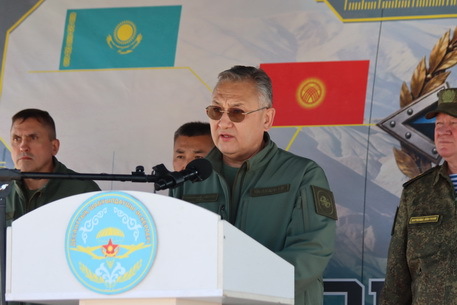
The closing ceremony of the exercise was attended by First Deputy Minister of Defense – Chief of the General Staff of the Armed Forces of the Republic of Kazakhstan Lieutenant General Kanysh Abubakirov, CSTO Secretary General Talatbek Masadykov, CSTO Joint Staff Chief Hero of Russia Andrey Serdyukov, representatives of the armed forces of Kazakhstan, Kyrgyzstan, Russia and Tajikistan, and invited officials.
Speaking at the closing ceremony, First Deputy Minister of Defense – Chief of the General Staff of the Armed Forces of the Republic of Kazakhstan Lieutenant General Kanysh Abubakirov said, in particular:
“An important and multifaceted task in protecting CSTO member states from external threats is to create a reliable mechanism for countering challenges capable of destabilizing the situation in the region, systematically strengthening it and putting it into practice.
An important issue remains increasing the combat and operational training of the forces and assets of the CSTO collective security system.
The Collective Rapid Deployment Forces exercise “Frontier” was first held on our territory back in August 2006 under the leadership of the Minister of Defense of the Republic of Kazakhstan.
Over the past 20 years, much has changed in the conduct of combat operations, the equipment and the procedures for employing military contingents.
“Frontier-2026” was conducted under conditions close to real ones. The exercise made it possible to develop and master new forms and methods of performing assigned tasks, as well as methods of employing modern weapons and military and special equipment.”
CSTO Secretary General Talatbek Masadykov, speaking at the ceremony, noted that “the joint exercise “Frontier-2026” was conducted according to a common concept and plan with the strategic command-and-staff exercise of the Armed Forces of the Republic of Kazakhstan “Batyl Toytarys-2026” (“Decisive Repulse-2026”).
The exercises were aimed at enhancing the interoperability of military command and control bodies and increasing the combat potential of the CSTO Collective Forces in the event of threats to the military security of a state in the Central Asian Collective Security Region.
The maneuvers were conducted amid a global deterioration in the international situation, requiring the development of effective mechanisms for ensuring military security in the CSTO area of responsibility.
Amid the growing potential for conflict in a number of regions of the world, the importance of the Central Asian Collective Security Region has increased significantly. The Republic of Kazakhstan serves as an economic and diplomatic bridge bringing together the potential of various states in the interests of ensuring regional security. Consistent reforms in the republic provide a solid foundation for strengthening the country's economic and military potential in the interests of collective security.
In accordance with the exercise concept, the training focused on the preparation and conduct of combat operations by the Collective Rapid Deployment Forces of the Central Asian Region, the organization of their operations, command and interaction with the armed forces, other troops and military formations of the Republic of Kazakhstan during a joint operation.
I note the coordinated and skillful actions of all national contingents of the Collective Rapid Deployment Forces of the Central Asian Region, as well as the active use of the experience of modern armed conflicts in planning and conducting combat operations. The exercises demonstrated the increased level of training of the command of the Collective Rapid Deployment Forces of the Central Asian Region and the coordinated work of commanders and staffs.
The exercise participants demonstrated a high level of professionalism and field training. All assigned tasks were completed on time and in full. I express my gratitude to all those who took part in preparing and conducting the exercise for their initiative and dedication.”
CSTO Joint Staff Chief Colonel General Andrey Serdyukov, addressing the exercise participants, said:
“Amid the instability of the geopolitical situation along the borders of the CSTO member states' area of responsibility and the intensified activities of international terrorist and extremist organizations, the main task of the CRDF remains readiness to repel external military aggression and respond promptly to threats to national and regional security.
I would like to emphasize that this year's concept of the “Frontier-2026” exercise is closely linked to the main operational and combat training event of the Armed Forces of Kazakhstan, the strategic command-and-staff exercise “Decisive Repulse-2026”. At the same time, particular attention in carrying out training and combat tasks was devoted to the phased preparation for an operation to deploy a joint command and control system and ensure sustained interaction between the organic and attached units of the Collective Rapid Deployment Forces, including with the Border Guard Service and National Guard of Kazakhstan.
At all stages of the exercise, actual combat experience was taken into account. Air defense cover and electronic warfare, the employment of and protection against unmanned aerial vehicles, which is particularly relevant on today's battlefield, were practiced. Units and subunits performing practical tasks in the challenging conditions of mountainous and desert terrain demonstrated a high level of professionalism, combat proficiency and operational cohesion.
This event was another step in the development of the CSTO Collective Forces. We can state with full confidence that the CRDF CAR are ready to counter modern challenges and threats.”
From September 13 to 18, the joint exercise with the Collective Rapid Deployment Forces of the Central Asian Region “Frontier-2026” was held at the Koktal training range under the leadership of Colonel Makhsut Gusseinov, Commander of the Air Assault Forces of the Armed Forces of the Republic of Kazakhstan.
The “Frontier-2026” joint exercise involved military contingents from Kazakhstan, Kyrgyzstan, Russia and Tajikistan, as well as operational groups from the CSTO Joint Staff and Secretariat. The Russian contingent was primarily composed of servicemen from the Central Military District serving with the 201st Guards Military Base. The exercise involved approximately 1,500 personnel and more than 300 items of military and special equipment, including 115 unmanned aerial vehicles for various purposes.
CSTO Joint Exercise Press Center
Republic of Kazakhstan, Edelweiss Training Center