On November 4, 2026, a working session entitled “The CSTO in Greater Eurasia: Current Status and Prospects” was held in Minsk as part of the 4th Minsk International Conference on Eurasian Security.
On November 3, 2026, the 4th Minsk International Conference on Eurasian Security was held in Minsk. The event was attended by President of the Republic of Belarus Alexander Lukashenko, Minister of Foreign Affairs of the Russian Federation Sergey Lavrov, CSTO Secretary General Talatbek Masadykov, CIS Secretary General Sergey Lebedev, SCO Secretary General Nurlan Yermekbayev, OSCE Secretary General Feridun Sinirlioğlu, representatives of the leadership of the foreign ministries of the Republic of Kazakhstan, the Kyrgyz Republic, the Republic of Tajikistan and a number of other states.
On October 30, 2026, the results of the “Channel-Caspian Lighthouse” subregional anti-drug operation were summed up as part of the implementation of the 2026 Plan of Key Activities of the Coordinating Council of Heads of Competent Drug Control Authorities of CSTO Member States (CCHCDCA).
From October 18 to 23 this year, in accordance with the 2026 Plan for the Joint Training of Command and Control Bodies and Formations of Forces and Assets of the Collective Security System of the Collective Security Treaty Organization, the “Cobalt-2026” special exercise was held at the Magob training range of the Special Purpose Units Training Center of the Ministry of Internal Affairs of the Republic of Tajikistan.
Preliminary results of the CSTO sub-regional counter-narcotics operation “Kanal – Amber Coast”
 04.07.2026
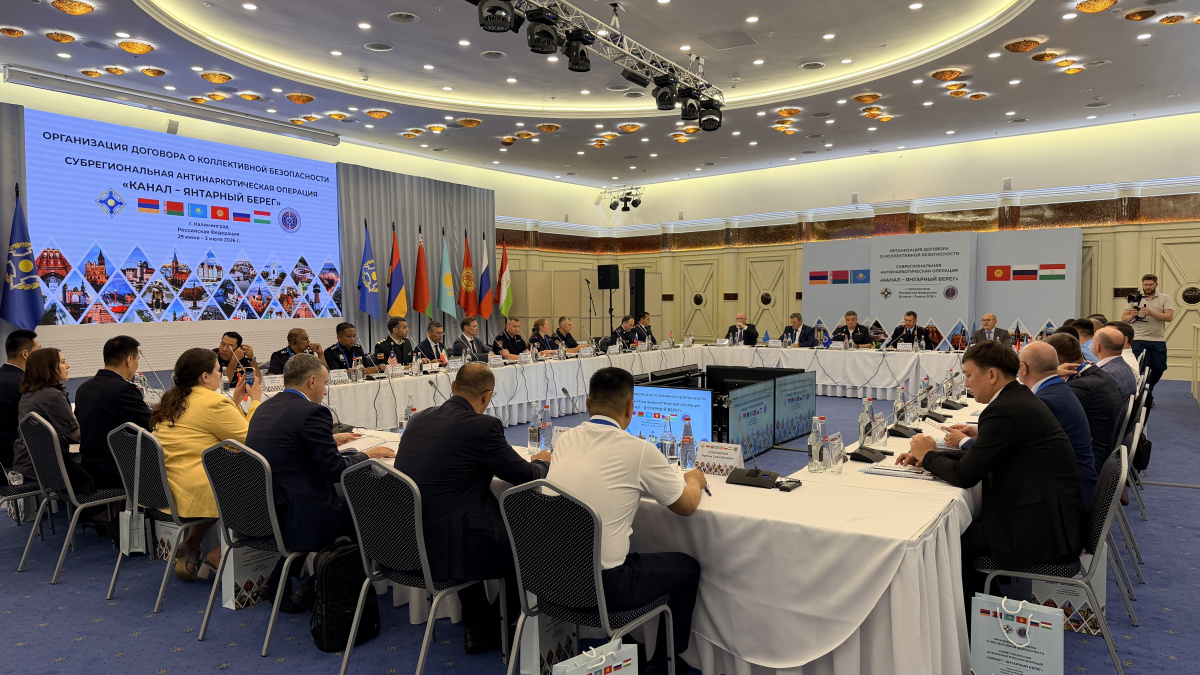
In accordance with the 2026 Action Plan of the Coordinating Council of Heads of the Competent Authorities for Countering Illicit Drug Trafficking of the CSTO Member States, and as part of the Russian Federation's priorities during its 2026 CSTO Chairmanship, the sub-regional counter-narcotics operation “Kanal – Amber Coast” was conducted from June 29 to July 3, 2026. The operation was aimed at disrupting trafficking routes for narcotic drugs, their precursors and analogues, new psychoactive substances, and potent substances into the CSTO area of responsibility, neutralizing international transnational drug trafficking groups, dismantling clandestine drug production facilities, undermining the economic foundations of the drug trade, including the laundering of drug proceeds.
The operation involved law enforcement agencies, border and customs authorities, state security services, and financial intelligence units of the CSTO member states, as well as observers from China, Iran, Malaysia, the Eurasian Group on Combating Money Laundering and Financing of Terrorism (EAG), the Central Asian Regional Information and Coordination Centre (CARICC), the Coordination Group of Heads of Competent Authorities for Combating Illicit Drug Trafficking of the Shanghai Cooperation Organization (CGCA SCO), and the Council of Commanders of the Border Troops of the CIS.
The International Coordination Headquarters directing the operation was deployed in Kaliningrad, Russian Federation.
Approximately 39,000 personnel from the competent authorities participated in the operation.
According to preliminary information provided by the national competent authorities, coordinated efforts during the operation resulted in the seizure of more than 3.5 tonnes of narcotic drugs and psychotropic substances in the CSTO member states, including 1,938 kg of opium, 519.2 kg of marijuana, 452.4 kg of hashish, 74.4 kg of mephedrone, 41.9 kg of α-PVP, and 182.6 kg of heroin. In addition, more than 2,441 kg of potent substances and over 1,096 kg of precursors were confiscated.
The operation also resulted in the seizure of more than 115,000 narcotic plants and 14,000 tablets containing prohibited substances.
Law enforcement authorities confiscated 24 firearms and approximately 680 rounds of ammunition of various calibres. A total of 521 drug-related crimes were identified, including 76 committed by organized groups and eight involving drug smuggling. Seven clandestine drug laboratories were dismantled. A total of 417 individuals were detained for drug-related offences, including 131 persons who had been on wanted lists. In addition, 1,376 internet websites used to distribute prohibited drug-related information were identified.
As part of the operation, financial monitoring and drug control services of the CSTO member states established operational cooperation, resulting in the identification of more than 2,000 suspicious financial transactions involving over 1,300 individuals suspected of participating in illicit drug trafficking. The total value of these transactions exceeded RUB 100 million, with most involving money transfers, cash deposits and withdrawals, the use of "drop" bank cards, and cryptocurrency transactions.
The competent authorities of the CSTO member states also carried out a number of international controlled deliveries. Several sophisticated drug smuggling routes were uncovered and disrupted, while seven cases involving the laundering of drug proceeds were documented.
The observer from Iran informed the members of the International Coordination Headquarters that large consignments of controlled substances had also been seized in Iran during the period of the CSTO operation.
On July 3, 2026, the preliminary results of the operation were reviewed at a meeting attended by Ivan Gorbunov, Head of the Main Directorate for Drug Control of the Ministry of Internal Affairs of Russia; Gennady Kazakevich, Deputy Minister of Internal Affairs of the Republic of Belarus; Zafar Samad, Director of the Drug Control Agency of the Republic of Tajikistan; Yerlan Abdikenov, Acting Chairman of the Committee for Combating Drug Crime of the Ministry of Internal Affairs of the Republic of Kazakhstan; Oleg Krylov, First Deputy Director of Rosfinmonitoring; and a representative of the CSTO Secretariat.