28 April marks the Day of the CSTO Joint Staff. It should be recalled that on 28 April 2003, in Dushanbe, the Collective Security Council, guided by the need to establish a military staff body responsible for implementing the military component of the Collective Security Treaty, adopted the Decision “On the Establishment of the Joint Staff of the Collective Security Treaty Organization.”
On 27 April 2026, within the framework of the International Scientific and Practical Conference “Contours of a New Architecture of Collective Security: Current Issues of Information and Analytical Partnership within the CSTO,” held at MGIMO University of the Ministry of Foreign Affairs of Russia, a round table entitled “Eurasian Analytical Platform: New Approaches in a New Geopolitical Reality” took place. During the event, Head of the Information and Public Relations Department of the CSTO Secretariat Yuriy Shuvalov delivered a presentation on “The Eurasian Analytical Network: A New Cognitive Architecture of Collective Security.”
Statement by the CSTO Secretary General at the opening of the International Scientific and Practical Conference “Contours of a New Architecture of Collective Security: Current Issues of Information and Analytical Partnership within the CSTO”
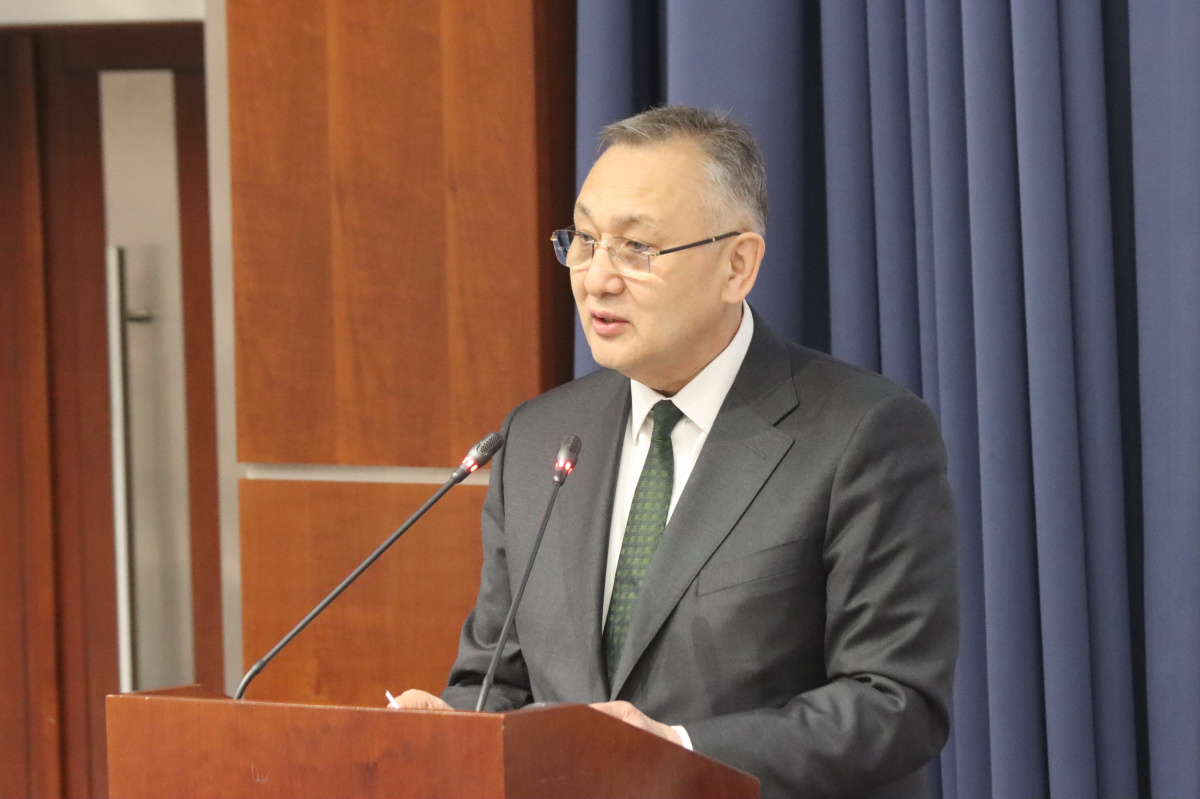 27.04.2026
Dear participants of the Conference,
Dear colleagues,
I am pleased to welcome you to the International Scientific and Practical Conference devoted to the issues of shaping a new architecture of collective security in Eurasia and to current aspects of developing information and analytical partnership.
I would like to thank our colleagues representing the SCO and CIS structures for supporting the initiative to hold this conference and for their participation in its preparation. I also express my gratitude to MGIMO University for hosting the event and acting as its co-organizer. I thank all participants who responded to our proposals. I am confident that today’s conference can lay the foundation for new joint projects and become one of our shared traditions.
Our meeting is taking place in the capital of the state holding the CSTO chairmanship, and the agenda of our conference is directly linked to the priorities of the Russian Federation’s chairmanship of the CSTO in 2026.
Let me recall that these priorities include:
– strengthening the role of the CSTO in shaping the architecture of Eurasian security,
– developing strong ties between the CSTO and the states of the Eurasian space and their integration associations,
– establishing the CSTO as a platform for broad discussion of current international issues in the field of security and defense, including holding an International Forum on Collective Security under the Organization’s auspices.
I believe that information and analytical partnership between CSTO structures and expert centers of CSTO, SCO and CIS member states is one of the areas directly linked to the implementation of these priorities.
Such cooperation is extremely relevant for assessing the situation in the CSTO area of responsibility and for developing new solutions. This is particularly important given that security threats in recent years have become increasingly acute. Moreover, both the international community as a whole and individual states face a shortage of practical experience in countering a number of challenges. These new problems are not always similar to those previously faced by humanity. One example is the challenges associated with the use of artificial intelligence. At the same time, even seemingly familiar threats are acquiring fundamentally new dimensions, as in the case of nuclear weapons.
Against the backdrop of growing threats, the situation in the field of international law is also a cause for serious concern. The institutions of international law — with the central role of the United Nations and the UN Security Council — are experiencing a profound crisis.
The principles of the supremacy of international law and the sovereign equality of states have no alternative. To reaffirm and restore their role, it is essential to turn to the historical experience and lessons on which these principles were established — namely, the lessons of the Second World War and the victory over Nazism and militarism.
It is no coincidence that on 3 September 2025, alongside the signing of the Roadmap for the Development of Cooperation between the CSTO, SCO and CIS, the Secretaries General of the three organizations adopted a joint statement marking the 80th anniversary of the end of the Second World War and the establishment of the United Nations.
Earlier, on 29 June 2025, representatives of expert and analytical centers of the CSTO member states put forward the Issyk-Kul Expert Initiative, calling in the year of the 80th anniversary of Victory for strengthening international cooperation among experts, scholars and public figures. Let me quote from that appeal: “Today the question is whether the generations of the 21st century will continue the best traditions of the 20th century and of all human history, or whether the world will be plunged into a new global military-political crisis, this time with the prospect of total destruction.” This assessment is well grounded.
Dear colleagues,
The convergence of views and positions expressed by the three Eurasian international organizations and by representatives of the expert community of our countries is already a solid basis for further partnership and cooperation. The growing attention to the regional level of security is also natural: today this level is key. It is here, in my view, that new approaches to ensuring security as collective and comprehensive must primarily be developed.
The idea of an emerging polycentric world order is becoming almost universally accepted. However, the polycentric nature of the world — where both states and their associations may act as centers — does not in itself predetermine relations between these poles. In the past, disagreements in polycentric systems were often resolved by military means. Today, we also see that some politicians and experts portray a multipolar world as one of military confrontation. It sometimes appears that certain military-political structures exclude from consideration the possibility of peaceful settlement of both existing and potential disagreements.
The CSTO member states adhere to a different approach. It is well known that our Organization possesses the necessary range of political and military capabilities and consistently strengthens them. Importantly, both the Treaty and the Charter of the CSTO enshrine the priority of political means in achieving the Organization’s objectives.
We believe that a polycentric world can and must be stable and secure. However, concrete answers to the question of how to achieve this under current, highly dynamic conditions still need to be formulated and refined. This is a key task not only for responsible international organizations, but also for those who prepare assessments, forecasts and recommendations in the field of international security.
I would add that the nature and contours of the polycentric world will likely be shaped by developments on the Eurasian continent. It is no coincidence that one of the important documents currently under development is the draft Eurasian Charter of Diversity and Multipolarity in the 21st Century. Its principles are addressed not only to Eurasia, but to the entire world, just as the initiative of building Greater Eurasia is a step toward security and justice on a global scale.
Ensuring collective and comprehensive security requires collective and comprehensive means. This makes it essential to involve expert and academic communities more broadly in the projects of our Organization and partner structures. Such work is already underway, but it must be elevated to a new, higher level.
In this regard, it would be useful to bring closer together the working agendas of international organizations and interested expert and analytical centers, and to increase the attention of the expert and academic community to issues of collective, pan-Eurasian security.
As for the calendar of expert events under the auspices of the CSTO and partner organizations, a tradition may well emerge of holding them in April. A start has already been made — with today’s conference and the conference “The Contribution of the Peoples of CSTO Member States to Victory in the Great Patriotic War,” held in April 2025. Thus, spring expert meetings could be held ahead of CSTO statutory body sessions, while in autumn a conference on Eurasian security, held with CSTO participation in Minsk, could take over this role.
Of course, alongside major forums, other formats of joint work are also necessary. The proposal to establish a Eurasian Analytical Platform has already been discussed preliminarily and will be discussed today. This includes the use of modern technologies to organize a permanent system of expert dialogue and joint project implementation.
You, distinguished participants, have before you a draft Address to the expert and academic communities of CSTO, SCO and CIS member states. The issue of establishing a Eurasian Analytical Platform as a format for regular interaction among experts and scholars is also reflected in this document.
In current conditions, scientific, expert and public dialogue can serve as a means of compensating for the deficit of political dialogue, which we observe even on the platforms of the United Nations. Eurasian expert dialogue could serve as an example for other structures and countries. Awareness of the need to restore dialogue where it has been curtailed or replaced by measures such as unilateral sanctions would be an important development for modern international relations.
These and other issues that you will raise are proposed for discussion today — first at the plenary session, and then at two working sessions. One will focus on integration projects in Eurasia and cooperation in ensuring collective security, while the other will address the consolidation of expert potential in the Eurasian space, as well as formats and parameters of such cooperation. In addition, a round table on the Eurasian Analytical Platform project is planned.
Dear colleagues,
Let me once again emphasize that our Organization is open to dialogue. The CSTO is committed to participating in dialogue, creating new platforms for dialogue, and developing those that already exist.
Our common task is to find solutions to existing problems. To do this, it is important to hear and understand all viewpoints, all existing opinions and positions. We do not seek to restrict the expression of views. We do not isolate anyone and do not intend to do so. We welcome respectful and equal dialogue — a dialogue about the future of Eurasia and of the entire world.
I wish our conference and all its participants every success.
I hereby declare the plenary session of the International Scientific and Practical Conference open.
Thank you for your attention.