28 April marks the Day of the CSTO Joint Staff. It should be recalled that on 28 April 2003, in Dushanbe, the Collective Security Council, guided by the need to establish a military staff body responsible for implementing the military component of the Collective Security Treaty, adopted the Decision “On the Establishment of the Joint Staff of the Collective Security Treaty Organization.”
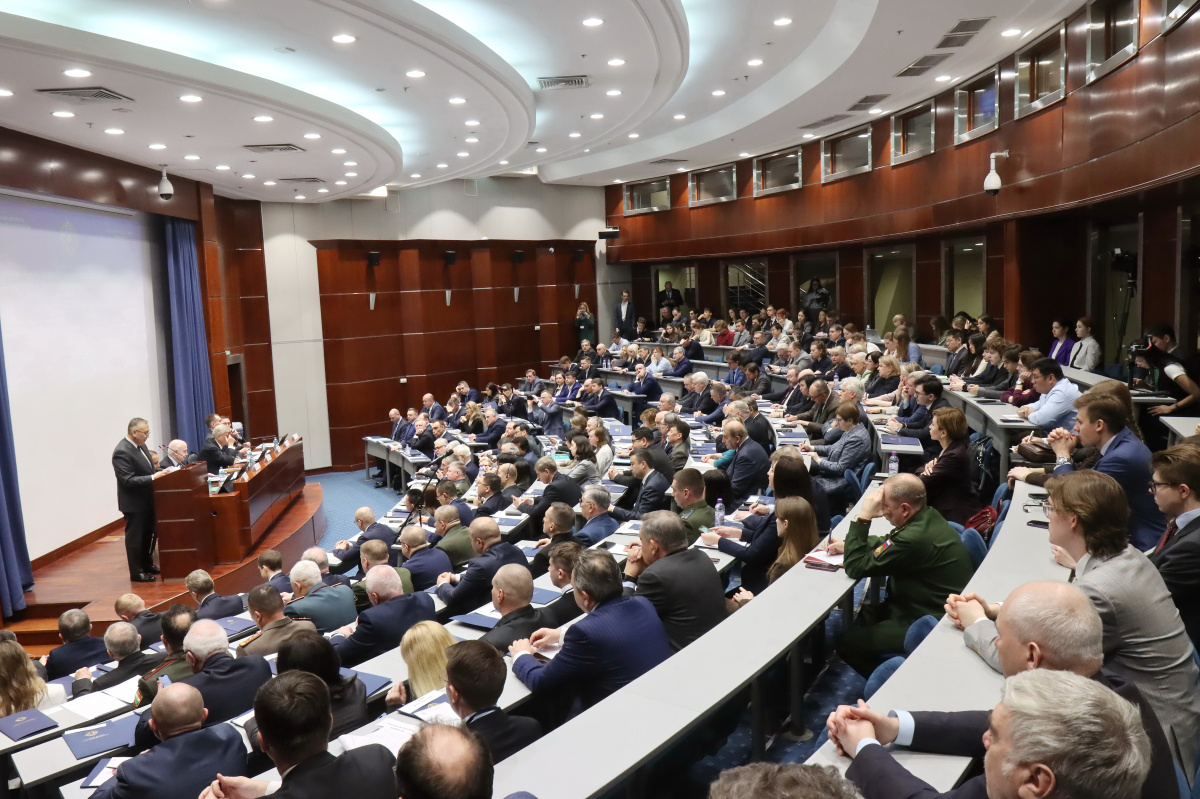
On 27 April 2026, within the framework of the International Scientific and Practical Conference “Contours of a New Architecture of Collective Security: Current Issues of Information and Analytical Partnership within the CSTO,” held at MGIMO University of the Ministry of Foreign Affairs of Russia, a round table entitled “Eurasian Analytical Platform: New Approaches in a New Geopolitical Reality” took place. During the event, Head of the Information and Public Relations Department of the CSTO Secretariat Yuriy Shuvalov delivered a presentation on “The Eurasian Analytical Network: A New Cognitive Architecture of Collective Security.”
Address of the International Conference “Contours of a New Architecture of Collective Security” to the expert community of the CSTO, CIS and SCO member states
 27.04.2026
We, the participants of the International Scientific and Practical Conference “Contours of a New Architecture of Collective Security: Current Issues of Information and Analytical Partnership within the CSTO,” representing the expert and academic communities of the member states of the aforementioned international organizations, having discussed current challenges and prospects for the development of political and security processes in the CSTO area of responsibility and adjacent regions, state the following:
The irreversibility of the process of formation of a polycentric world order, accompanied by the strengthening of inter-civilizational dialogue within the framework of the Global Majority.
The aggravation of contradictions between states and associations at the regional and global levels, often accompanied by military actions, hybrid attacks, interventions, and the use of economic and political-diplomatic pressure.
Crisis phenomena in a number of regions, tending toward escalation, may lead to irreparable consequences, including the use of weapons of mass destruction.
The potential for development and peaceful progress under conditions of stability, based on adherence to the principles of the United Nations, is under threat. The expansion of conflicts and the transformation of their nature endanger millions of people in various regions of the world.
The necessity of developing and applying joint measures capable of preventing negative scenarios and ensuring reliable peace and stability in Eurasia.
The critical importance of high-quality analytical, expert and scientific support for decision-making processes in the field of security and for the assessment of their implementation.
Based on the results of the discussions, we call for:
Promoting the joint development of approaches to the harmonization and implementation of agreements defining the rules and norms of international interaction in resolving contradictions between states and intergovernmental associations, and in creating conditions for the development and prosperity of countries and peoples. A basis for preparing a universal document regulating key issues of strengthening peace and security could be the Eurasian Charter of Diversity and Multipolarity in the 21st Century, initiated by the Russian and Belarusian sides.
Supporting the Issyk-Kul expert initiative of the CSTO aimed at consolidating the efforts of expert and academic communities of the CSTO, CIS and SCO member states in studying issues of politics and security, as well as in developing collective approaches to ensuring peace, stability and sustainable development.
Considering the CSTO, along with other international associations in Eurasia, as one of the core elements of the emerging Eurasian security system. Ensuring institutional-level interaction among these associations in order to develop recommendations aimed at optimizing political practices in the field of security.
Establishing a Eurasian Analytical Platform within the CSTO framework as a format for regular interaction among the expert and academic communities of the member states.
Intensifying efforts to provide information support for the CSTO, CIS and SCO initiatives in the field of security in order to build broad and sustainable public support for the policies of these organizations.